

Best Preparations of MCD-Level-2 Exam 2024 MuleSoft Certified Developer Unlimited 62 Questions
Focus on MCD-Level-2 All-in-One Exam Guide For Quick Preparation.
NEW QUESTION # 12
Refer to the exhibit.
What is the result of the Mule Maven Plugin configuration of the value of property its,keystorePassoword in CloudHub 2.0?
- A. Anypoint Studio secures the value
- B. CloudHub encrypts the value
- C. The Mule server encrypts the value
- D. Runtime Manager masks the value
Answer: D
Explanation:
Explanation
The result of the Mule Maven Plugin configuration of the value of property its,keystorePassword in CloudHub
2.0 is that Runtime Manager masks the value. This means that Runtime Manager hides or obscures the value from anyone who views it in Runtime Manager or Anypoint Platform. References:
https://docs.mulesoft.com/runtime-manager/runtime-manager-agent-for-mule4#properties-tab
NEW QUESTION # 13
A system API that communicates to an underlying MySQL database is deploying to CloudHub. The DevOps team requires a readiness endpoint to monitor all system APIs.
Which strategy should be used to implement this endpoint?
- A. Create a dedicated endpoint that responds with the API status only
- B. Create a dedicated endpoint that responds with the API status and reachability of the underlying systems
- C. Use an existing resource endpoint of the API
- D. Create a dedicated endpoint that responds with the API status and health of the server
Answer: B
Explanation:
Explanation
To implement a readiness endpoint to monitor all system APIs, the developer should create a dedicated endpoint that responds with the API status and reachability of the underlying systems. This way, the DevOps team can check if the system API is ready to receive requests and if it can communicate with its backend systems without errors. References:
https://docs.mulesoft.com/mule-runtime/4.3/deployment-strategies#readiness-probes
NEW QUESTION # 14
A company deploys 10 public APIs to CloudHub. Each API has its individual health endpoint defined. The platform operation team wants to configure API Functional Monitoring to monitor the health of the APIs periodically while minimizing operational overhead and cost.
How should API Functional Monitoring be configured?
- A. From 10 public locations with each API in its own schedule
- B. From one public location with each API in its own schedule
- C. From one public location with all 10 APIs in a single schedule
- D. From one private location with all 10 APIs in a single schedule
Answer: C
Explanation:
Explanation
To configure API Functional Monitoring to monitor the health of 10 public APIs periodically while minimizing operational overhead and cost, the developer should use one public location with all 10 APIs in a single schedule. A public location is a worker that runs in a CloudHub shared environment, which is cheaper and easier to maintain than a private location. A single schedule allows running all 10 APIs tests at the same time and frequency, which reduces complexity and resource consumption. References:
https://docs.mulesoft.com/functional-monitoring/fm-create-monitor#create-a-monitor
NEW QUESTION # 15
A Flight Management System publishes gate change notification events whenever a flight's arrival gate changes. Other systems, including Baggage Handler System. Inflight Catering System and Passenger Notifications System, must each asynchronously receive the same gate change notification to process the event according.
Which configuration is required in Anypoint MQ to achieve this publish/subscribe model?
- A. Publish each client subscribe directly to the exchange.
Have each client subscribe directly to the queue. - B. Publish the gate change notification to an Anypoint MQ queue.
Create different anypoint MQ exchange meant for each of the other subscribing systems Bind the queue with each of the exchanges - C. Publish the gate change notification to an Anypoint MQ exchanhe.
Create different Anypoint MQ queues meant for each of the other subscribing systems.
Bind the exchange with each of the queues. - D. Publish the gate change notification to an Anypoint MC queue
Have each client subscribe directly to the queue
Answer: C
Explanation:
Explanation
To achieve a publish/subscribe model using Anypoint MQ, where each system receives the same gate change notification event, the developer should publish the gate change notification to an Anypoint MQ exchange, create different Anypoint MQ queues meant for each of the other subscribing systems, and bind the exchange with each of the queues. An exchange is a message routing agent that can send messages to different queues based on predefined criteria. By binding an exchange with multiple queues, each queue receives a copy of every message sent to that exchange. Therefore, each system can subscribe to its own queue and receive every gate change notification event. References:
https://docs.mulesoft.com/anypoint-mq/3.x/anypoint-mq-exchanges
NEW QUESTION # 16
A Mule application for processing orders must log the order ID for every log message output.
What is a best practice to enrich every log message with the order ID?
- A. Create a custom XML SDK component to wrap the logger processor and automatically add the order ID within the connector
- B. Use the Tracing module to set logging variables with a Mapped Diagnostic Context
- C. Use flow variables within every logger processor to log the order ID
- D. Set a flow variable and edit the log4/2.xml file to output the variable as part of the message pattern
Answer: B
Explanation:
Explanation
To enrich every log message with the order ID, the developer should use the Tracing module to set logging variables with a Mapped Diagnostic Context (MDC). The Tracing module allows adding custom key-value pairs to log messages using MDC variables. The developer can use Set Logging Variables operation to set the order ID as an MDC variable and then use it in any logger processor within the same thread or event.
References: https://docs.mulesoft.com/tracing-module/1.0/tracing-module-reference#set-logging-variables
NEW QUESTION # 17
Refer to the exhibit.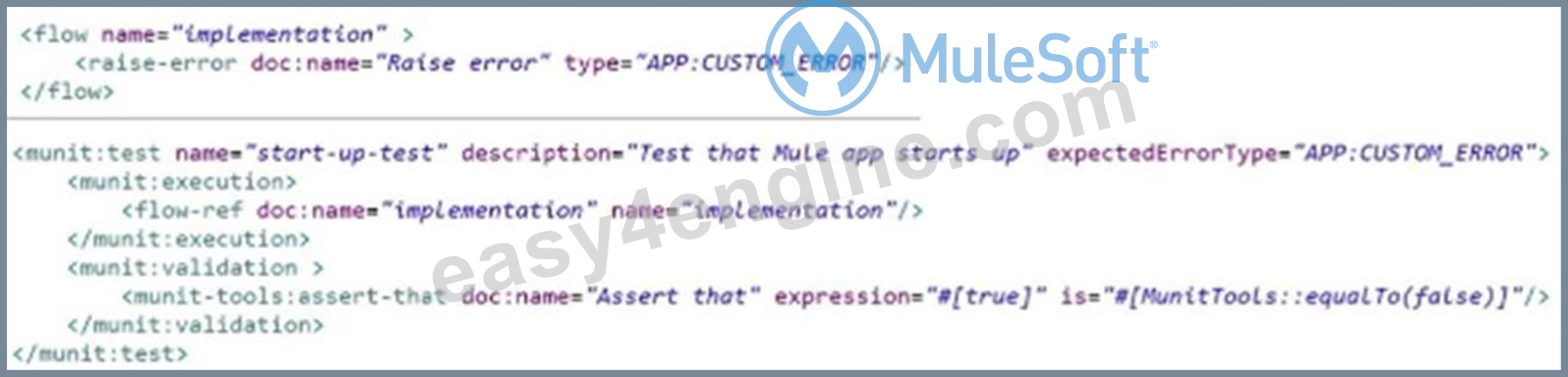
The flow name is ''implementation'' with code for the MUnit test case.
When the MUnit test case is executed, what is the expected result?
- A. The test case fails with an unexpected error type
- B. The test case passes
- C. The test case fails with an assertion error
- D. The test throws an error and does not start
Answer: C
Explanation:
Explanation
Based on the code snippet and MUnit test case below, when the MUnit test case is executed, the expected result is that the test case fails with an assertion error. This is because the assert-equals processor compares two values for equality, and fails if they are not equal. In this case, the expected value is 'Hello World', but the actual value returned by the implementation flow is 'Hello Mule'. Therefore, the assertion fails and an error is thrown. References: https://docs.mulesoft.com/munit/2.3/assert-equals-processor
NEW QUESTION # 18
Which configurations are required for HTTP Listener to enable mTLS authentication?
- A. Set an appropriate keystore and truststore configuration for the listener
- B. Set an appropriate reconnection strategy and use persistent connections for the listener
- C. Set an appropriate keystore configuration and use persistent connections for the listener
- D. Set an appropriate truststore configuration and reconnection strategy for the listener
Answer: A
Explanation:
Explanation
To enable mTLS authentication for HTTP Listener, the developer needs to set an appropriate keystore and truststore configuration for the listener. The keystore contains the certificate and private key of the Mule application that are used to prove its identity to clients. The truststore contains the certificates of trusted clients that are allowed to access the Mule application. References:
https://docs.mulesoft.com/mule-runtime/4.3/tls-configuration#mutual-authentication
NEW QUESTION # 19
Which command is used to convert a JKS keystore to PKCS12?
- A. Keytool-importkeystore -srckeystore keystore jks-srcstoretype JKS -destkeystore keystore.p13
-deststoretype PKCS12 - B. Keytool-importkeystore -srckeystore keystore p12-srcstoretype JKS -destkeystore keystore.p12
-deststoretype PKCS12 - C. Keytool-importkeystore -srckeystore keystore jks-srcstoretype PKCS12 -destkeystore keystore.p12
-deststoretype JKS - D. Keytool-importkeystore -srckeystore keystore p12-srcstoretype PKCS12 -destkeystore keystore.jks
-deststoretype JKS
Answer: B
Explanation:
Explanation
To convert a JKS keystore to PKCS12, the developer needs to use the keytool-importkeystore command with the following options: -srckeystore keystore.jks -srcstoretype JKS -destkeystore keystore.p12 -deststoretype PKCS12. This command imports all entries from a source JKS keystore (keystore.jks) into a destination PKCS12 keystore (keystore.p12). References:
https://docs.oracle.com/en/java/javase/11/tools/keytool.html#GUID-5990A2E4-78E3-47B7-AE75-6D182625954
NEW QUESTION # 20
Which properties are mandatory on the HTTP Connector configuration in order to use the OAuth 2.0 Authorization Code grant type for authentication?
- A. External callback URL, access token URL, client ID response access token
- B. Token URL, authorization URL, client ID, client secret local callback URL
- C. External callback URL, access token URL, client ID, response refresh token
- D. External callback URL, access token URL, local authorization URL, authorization URL, client ID, client secret
Answer: B
Explanation:
Explanation
To use the OAuth 2.0 Authorization Code grant type for authentication, the HTTP Connector configuration requires the following properties: token URL, authorization URL, client ID, client secret, and local callback URL. The token URL is the endpoint of the authorization server that provides access tokens. The authorization URL is the endpoint of the authorization server that initiates the user consent flow. The client ID and client secret are the credentials of the Mule application registered with the authorization server. The local callback URL is the endpoint of the Mule application that receives the authorization code from the authorization server.
References: https://docs.mulesoft.com/http-connector/1.6/http-authentication#oauth-2-0
NEW QUESTION # 21
A Mule application contain two policies Policy A and Policy A has order1, and Policy B has order 2. Policy A Policy B, and a flow are defined by he configuration below.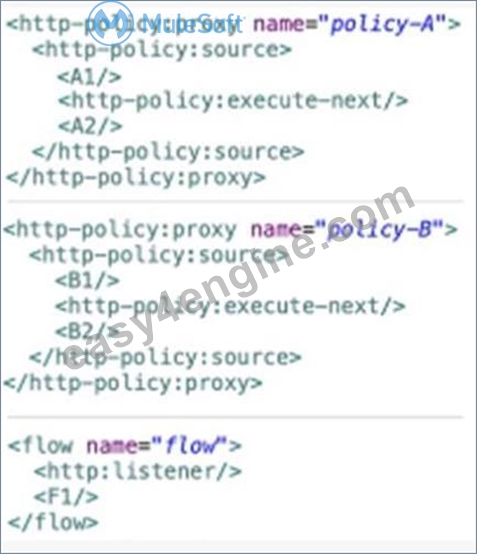
When a HTTP request arrives at the Mule application's endpoint, what will be the execution order?
- A. A1, B1, F1, B2, A2
- B. F1, B1, A1, A2, B2
- C. F1, A1, B1, B2, A2
- D. B1, A1, F1, A2, B2
Answer: A
Explanation:
Explanation
Based on the configuration below, when a HTTP request arrives at the Mule application's endpoint, the execution order will be A1, B1, F1, B2, A2. This is because policies are executed before and after the API implementation flow according to their order attribute. Policy A has order 1, which means it is executed first before Policy B, which has order 2. The flow is executed after both policies are executed before the flow.
Then, Policy B is executed after the flow before Policy A is executed after the flow. References:
https://docs.mulesoft.com/api-manager/2.x/policies-policy-order
NEW QUESTION # 22
Two APIs are deployed to a two-node on-prem cluster. Due to a requirements change, the two APIs must communicate to exchange data asynchronously.
- A. Instead of using the VM Connector use <flow-ref>directly
- B. If the two APIs use the same domain, the VM Connector can be leveraged
- C. The VM Connector is used to inter-application communication, so it is not possible to use the VM Connector
- D. It is not possible to use the VM Connector since the APIs are running in a cluster mode and each mode has it own set of VM Queues
Answer: B
Explanation:
Explanation
To communicate asynchronously between two APIs deployed to a two-node on-prem cluster, the developer can use the VM Connector if the two APIs use the same domain. The VM Connector allows passing messages between different Mule applications within a single Mule runtime instance or across different instances using shared memory or persistent storage. If two APIs are deployed under the same domain, they can share resources such as VM queues and communicate asynchronously using VM Connector operations. References:
https://docs.mulesoft.com/mule-runtime/4.3/vm-connector
https://docs.mulesoft.com/mule-runtime/4.3/shared-resources
NEW QUESTION # 23
A Mule implementation uses a HTTP Request within an Unit Successful scope to connect to an API.
How should a permanent error response like HTTP:UNAUTHORIZED be handle inside Until Successful to reduce latency?
- A. Put the HTTP Request inside a try scope in Unit Successful.
In the error handler, use On Error Continue to catch permanent errors like HTTP UNAUTHORIZED. - B. Put the HTTP Request inside a try scope in Unit Successful.
In the error handler, use On Error Propagate to catch permanent errors like HTTP UNAUTHORIZED. - C. Configure retrying until a MULERETRY_EXHAUSTED error is raised or the API responds back with a successful response.
- D. In Until Successful configuration, set the retry count to 1 for error type HTTP: UNAUTHORIZED.
Answer: A
Explanation:
Explanation
To handle a permanent error response like HTTP:UNAUTHORIZED inside Until Successful, the developer should put the HTTP Request inside a try scope in Unit Successful, and use On Error Continue to catch permanent errors like HTTP UNAUTHORIZED in the error handler. This way, the developer can avoid retrying requests that will always fail due to a permanent error, and reduce latency. On Error Continue allows the flow to continue processing after handling the error. References:
https://docs.mulesoft.com/mule-runtime/4.3/until-successful-scope
https://docs.mulesoft.com/mule-runtime/4.3/on-error-continue-concept
NEW QUESTION # 24
A scatter-gather router is configured with four routes:Route A, B, C and D.
Route C false.
- A. Payload failures['2']
- B. Payload ['2']
- C. Error,errorMesage.payload.results ['2']
- D. Error,errorMessage,payload.failures['2']
Answer: D
Explanation:
Explanation
The result of accessing route C failure is Error,errorMessage,payload.failures['2']. This is because a scatter-gather router returns an aggregated message that contains an array of results from each route and an array of failures from each route. The failures array contains error objects with information about each failed route execution. To access route C failure, which is the third route (index 2), the developer needs to use Error.errorMessage.payload.failures['2'] expression. References:
https://docs.mulesoft.com/mule-runtime/4.3/scatter-gather-reference#scatter-gather-output
NEW QUESTION # 25
Which statement is true when working with correlation IDS?
- A. The HTTP Listener regenerates correlation IDs regardless of the HTTP request
- B. The VM Connector does not automatically propagate correction IDs
- C. The HTTP Listener generates correlation IDS unless a correlation ID is received in the HTTP request
- D. The Anypoint MQ Connector automatically propagates correlation IDS
Answer: C
Explanation:
Explanation
When working with correlation IDs, the HTTP Listener generates correlation IDs unless a correlation ID is received in the HTTP request. In that case, it propagates the received correlation ID throughout the flow execution. Correlation IDs are used to track events across different flows or applications. References:
https://docs.mulesoft.com/mule-runtime/4.3/about-mule-message#message-attributes
NEW QUESTION # 26
Refer to the exhibit.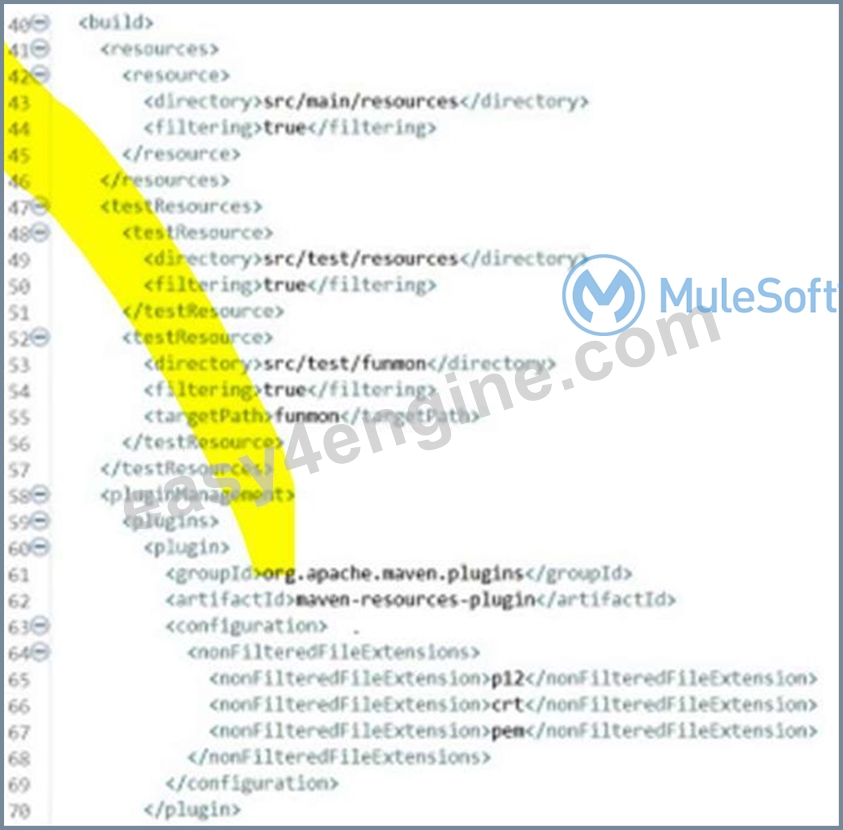
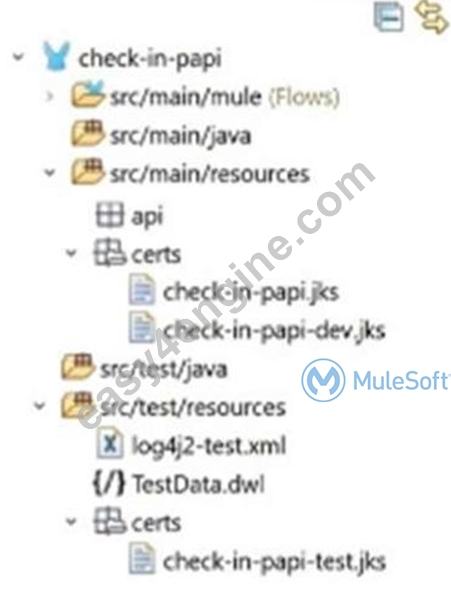
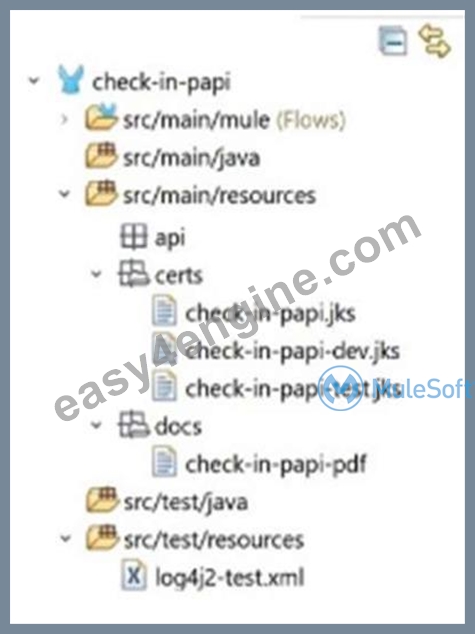
A Mule application pom.xml configures the Maven Resources plugin to exclude parsing binary files in the project's src/main/resources/certs directory.
Which configuration of this plugin achieves a successful build?
- A.
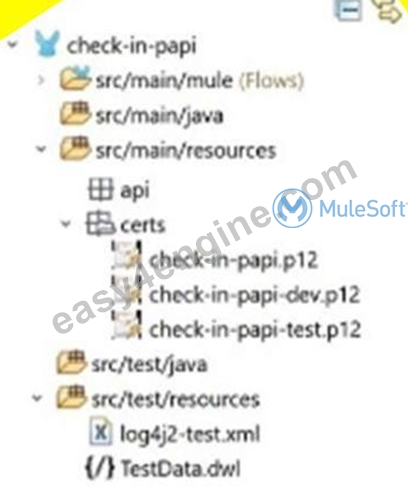
- B.
- C.

- D.
Answer: C
Explanation:
Explanation
To configure the Maven Resources plugin to exclude parsing binary files in the project's src/main/resources/certs directory, option C should be used. This option specifies that any files with .cer or .jks extensions under the certs directory should be excluded from filtering. Filtering is a process of replacing placeholders with actual values in resource files during the build process. Binary files should not be filtered because they may become corrupted or unusable. References:
https://maven.apache.org/plugins/maven-resources-plugin/examples/filter.html
https://maven.apache.org/plugins/maven-resources-plugin/examples/include-exclude.html
NEW QUESTION # 27
A Mule application need to invoice an API hosted by an external system to initiate a process. The external API takes anywhere between one minute and 24 hours to compute its process.
Which implementation should be used to get response data from the external API after it completes processing?
- A. Expose an HTTP callback API in Mule and register it with the external system
- B. Use an HTTP Connector inside Async scope to invoice the API and wait for a response
- C. Use a Scheduler to check for a response every minute
- D. Use an HTTP Connector to invoke the API and wait for a response
Answer: A
Explanation:
Explanation
To get response data from the external API after it completes processing, the developer should expose an HTTP callback API in Mule and register it with the external system. This way, the external API can invoke the callback API with the response data when it is ready, instead of making the Mule application wait for a long time or poll for a response repeatedly. References:
https://docs.mulesoft.com/mule-runtime/4.3/http-listener-ref#callback
NEW QUESTION # 28
A mule application exposes and API for creating payments. An Operations team wants to ensure that the Payment API is up and running at all times in production.
Which approach should be used to test that the payment API is working in production?
- A. Configure the application to send health data to an external system
- B. Create a health check endpoint that listens on a separate port and uses a separate HTTP Listener configuration from the API
- C. Create a health check endpoint that reuses the same port number and HTTP Listener configuration as the API itself
- D. Monitor the Payment API directly sending real customer payment data
Answer: B
Explanation:
Explanation
To test that the payment API is working in production, the developer should create a health check endpoint that listens on a separate port and uses a separate HTTP Listener configuration from the API. This way, the developer can isolate the health check endpoint from the API traffic and avoid affecting the performance or availability of the API. The health check endpoint should return a simple response that indicates the status of the API, such as OK or ERROR. References:
https://docs.mulesoft.com/api-functional-monitoring/afm-create-monitor#create-a-monitor
NEW QUESTION # 29
......
Guaranteed Success with MCD-Level-2 Dumps: https://www.easy4engine.com/MCD-Level-2-test-engine.html
