

Download Free PMI PMI-RMP Real Exam Questions Download
Latest PMI PMI-RMP Real Exam Dumps PDF
NEW QUESTION # 25
Who is responsible for the stakeholder expectations management in a high-profile, high-risk project?
- A. Project management office
- B. Project sponsor
- C. Project manager
- D. Project risk assessment officer
Answer: C
NEW QUESTION # 26
You work as a project manager for BlueWell Inc. You are preparing to plan risk responses for your project with your team. How many risk response types are available for a negative risk event in the project?
- A. Three
- B. Four
- C. Seven
- D. One
Answer: B
NEW QUESTION # 27
You are the project manager of the GHY project. In your organization you must follow certain enterprise environmental factors that establish the rules for risk management . One of the policies your project must adhere to requires periodic rapid analysis of risks within the project. These rapid, cost-effective session must be documented and performed monthly. What type of analysis are you required to perform according to your enterprise environmental factors?
- A. Delphi Technique
- B. Qualitative analysis
- C. Brainstorming
- D. Quantitative analysis
Answer: B
NEW QUESTION # 28
A project has a significant impact on an organization. Multiple stakeholders expressed concerns regarding the overall project risk during construction of the risk management plan, and they agreed that the risk appetite is low.
What should the project risk manager monitor closely?
- A. Risk breakdown structure (RBS)
- B. Risk response strategies
- C. Risk thresholds
- D. Risk management reports
Answer: C
Explanation:
Explanation
The project risk manager should monitor risk thresholds closely, as they represent the organization's risk appetite. In a project with a low risk appetite, it is essential to ensure that risks are managed within the defined thresholds to address stakeholders' concerns and maintain their confidence in the project's success.
NEW QUESTION # 29
Frank is the project manager of the NHH Project. He is working with the project team to create a plan to document the procedures to manage risks throughout the project. This document will define how risks will be identified and quantified. It will also define how contingency plans will be implemented by the project team.
What document is Frank and the NHH Project team creating in this scenario?
- A. Project management plan
- B. Risk management plan
- C. Resource management plan
- D. Project plan
Answer: B
Explanation:
Explanation/Reference:
NEW QUESTION # 30
Wendy is the project manager of the NNJ project for her company. As part of the variance and trend analysis tool and technique for risk governance she is using earned value management. In this approach, Wendy wants to track and compare the cost and schedule variances. What is the point of this tool and technique in regard to risk?
- A. Wendy can track the cost and schedule variances.
- B. Wendy can determine a true project completion date.
- C. Wendy can review quality performance on baselines.
- D. Wendy can forecast deviation of the project cost and schedule for completion targets.
Answer: D
NEW QUESTION # 31
You work as the project manager for BlueWell Inc. You are monitoring the project performance. You want to make a decision to change the project plan to eliminate a risk in order to protect the project objectives. Which of the following strategies will you use to tackle the risk?
- A. Risk transference
- B. Risk avoidance
- C. Risk acceptance
- D. Risk mitigation
Answer: B
NEW QUESTION # 32
You work as a project manager for SoftTech Inc. You are working with the project stakeholders to begin the qualitative risk analysis process. You will need all of the following as inputs to the qualitative risk analysis process except for which one?
- A. Project scope statement
- B. Risk register
- C. Risk management plan
- D. Stakeholder register
Answer: D
NEW QUESTION # 33
A project manager works on a long-term and high visibility project at an organization that has a low risk appetite towards this project due to its impact on the company's business. The project sponsors follow up weekly with the project manager, who was just informed by one of the risk owners that the exposure from two high-impact risks are hitting the risk thresholds.
What should the project manager do next?
- A. Complete an assessment and confirm the response with the sponsors.
- B. Update the project management plan to add contingency.
- C. Perform an assumptions and constraints analysis.
- D. Implement mitigation measures for those risks.
Answer: A
Explanation:
Explanation
The project manager should complete an assessment of the high-impact risks and confirm the response with the project sponsors (C) since the organization has a low risk appetite for this project. This approach ensures that the sponsors are aware of the situation and can provide guidance on how to proceed. This is in line with PMI's PMBOK Guide, Sixth Edition.
NEW QUESTION # 34
Nancy is the project manager of the NHH project. She and the project team have identified a significant risk in the project during the qualitative risk analysis process. Bob is familiar with the technology that the risk is affecting and proposes to Nancy a solution to the risk event. Nancy tells Bob that she has noted his response, but the risk really needs to pass through the quantitative risk analysis process before creating responses. Bob disagrees and ensures Nancy that his response is most appropriate for the identified risk. Who is correct in this scenario?
- A. Bob is correct. Bob is familiar with the technology and the risk event so his response should be implemented.
- B. Nancy is correct. Because Nancy is the project manager she can determine the correct procedures for risk analysis and risk responses. In addition, she has noted the risk response that Bob recommends.
- C. Nancy is correct. All risks of significant probability and impact should pass the quantitative risk analysis process before risk responses are created.
- D. Bob is correct. Not all risk events have to pass the quantitative risk analysis process to develop effective risk responses.
Answer: D
NEW QUESTION # 35
Within the organizational process assets, where would the project manager find risk response effectiveness from past projects?
- A. Risk audit and lessons learned
- B. Stakeholder register and lessons learned
- C. Risk audit and risk matrix
- D. Change management plan and lessons learned
Answer: D
NEW QUESTION # 36
You are the project manager of the NJJ project. Your enterprise environmental factors require that you establish certain risk management rules regarding low risks within your project. What is the best policy for risks with low probability and low impact in the project management?
- A. These risks should be placed on a watchlist for future monitoring.
- B. These risks should be accepted.
- C. These risks should be identified, but dismissed.
- D. These risks should be placed in the risk register.
Answer: A
Explanation:
Explanation/Reference:
NEW QUESTION # 37
A company is executing a high-visibility project to develop mobile phone technology. The project sponsor is concerned that an overall high risk rating may undermine support for the project within the company. The sponsor has instructed the project manager to manipulate the data used for Monte Carlo simulation to artificially reduce the risk rating. What should the project manager do?
- A. Modify the data.
- B. Schedule a face-to-face meeting with the project sponsor.
- C. Email the project sponsor explaining why the data should not be modified.
- D. Ignore the request.
Answer: C
Explanation:
Explanation
NEW QUESTION # 38
Mike is the project manager of the NNP Project for his organization. He is working with his project team to plan the risk responses for the NNP Project. Mike would like the project team to work together on establishing risk thresholds in the project. What is the purpose of a risk threshold?
- A. It is a limit of the funds that can be assigned to risk events.
- B. It is a warning sign that a risk event is going to happen.
- C. It is a study of the organization's risk tolerance.
- D. It helps to identify those risks for which specific responses are needed.
Answer: C
NEW QUESTION # 39
Gary has identified a project risk that could injure project team members. He does not want to accept any risk where someone could become injured on this project so he hires a professional vendor to complete this portion of the project work. This workaround to the risk event is known as what type of risk response?
- A. Mitigation
- B. Avoidance
- C. Acceptance
- D. Transference
Answer: D
NEW QUESTION # 40
In order to monitor risks in an infrastructure improvement project, the risk manager uses methods to support effective responses to risks that have occurred. Which of the following is an example of such a method?
- A. Ongoing risk response analysis and risk audits as required
- B. Risk analysis and risk register review
- C. Risk analysis and performance reports preparation
- D. Risk audits and change request review
Answer: A
NEW QUESTION # 41
A new risk manager has been hired on a project and meets with the project director. The project director supplies the project's risk register and asks the risk manager for an analysis of its effectiveness.
What two actions should the risk manager do next? (Choose two.)
- A. Check to ensure that the risks are gathered using Delphi technique.
- B. Check for risk classification and that probability and impact are identified.
- C. Check to ensure that the risk is supported by a Monte Carlo simulation.
- D. Check to ensure that risk origin, triggering event, and ownership is identified.
- E. Check to ensure the risk meeting agenda and supporting documents are distributed.
Answer: B,D
Explanation:
Explanation
The risk manager should first check the risk register for proper risk classification, probability, and impact (C), as these are essential components of an effective risk management process. Next, the risk manager should ensure that the risk origin, triggering events, and ownership are identified (D), as this information helps in assigning responsibilities and taking appropriate actions for each risk. References to these steps can be found in the Project Management Institute's (PMI) A Guide to the Project Management Body of Knowledge (PMBOK Guide), Sixth Edition.
NEW QUESTION # 42
You are project manager for ABD project. You, with your team, are working on the following activities:
Probabilistic analysis of a project.
Probability of achieving cost and time objectives.
Trends in Qualitative Risk Analysis results.
On which of the following processes are you working on?
- A. Identify Risks
- B. Perform Qualitative Risk Analysis
- C. Perform Quantitative Risk Analysis
- D. Plan Risk Management
Answer: C
NEW QUESTION # 43
You are the project manager of the GYH project for your organization. Management has asked you to begin identifying risks and to use an information gathering technique. Which one of the following risk identification approaches is an information gathering technique?
- A. Root cause analysis
- B. Documentation reviews
- C. SWOT analysis
- D. Assumptions analysis
Answer: A
NEW QUESTION # 44
____ analysis is a statistical concept that calculates the average outcome when the future includes scenarios that may or may not happen.
- A. Expected monetary value
- B. Expert judgment
- C. Sensitivity
- D. Modeling and simulation
Answer: A
NEW QUESTION # 45
Henry is the project manager of the QBG Project for his company. This project has a budget of $4,576,900 and is expected to last 18 months to complete. The CIO, a stakeholder in the project, has introduced a scope change request for additional deliverables as part of the project work. What component of the change control system would review the proposed changes' impact on the features and functions of the project's product?
- A. Integrated change control
- B. Scope change control system
- C. Cost change control system
- D. Configuration management system
Answer: D
NEW QUESTION # 46 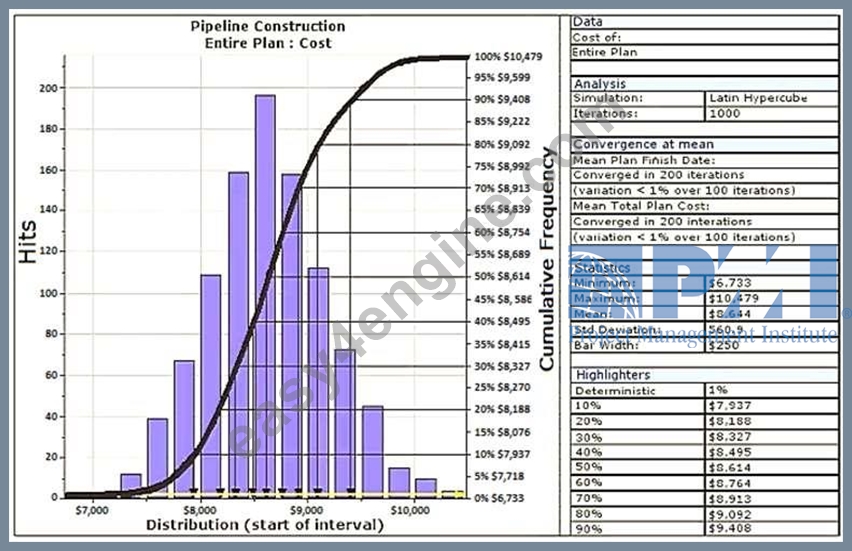
The project values are in thousands. The project manager has a budget of US$8,000,000 for this project and asks how much more would be needed to add to the contingency reserve for a P40?
- A. US$644,000
- B. US$495,000
- C. US$764,000
- D. US$247,500
Answer: B
NEW QUESTION # 47
......
Key Details to Know
The PMI-RMP certification exam contains a total of 170 multiple-choice questions, which are to be completed within the allocated timeframe of 210 minutes. The test has a tutorial and a survey that are optional for every candidate. Each of them can take at least 15 minutes of your time. However, this time is not included in the exam time of 210 minutes. 20 questions out of 170 are pretest items, so they do not affect your overall score. These questions are included in the content of this test to legitimize its validity. The computer-based exam is administered by the Pearson VUE testing company and is delivered in the English language only. The exam will cost you $520 if you are a PMI member and $670 if you are a non-member. If you fail the test at your first attempt, you will have the opportunity for two retakes within a 1-year eligibility period. The retake fee amounts to $335 for the members and $435 for the non-members.
The PMI-RMP certificate required renewal every three years. To maintain your certification status, you will need to earn 30 Professional Development Units (PDUs) in the risk management domain with a 3-year period.
The PMI-RMP certification is an excellent option for individuals who want to demonstrate their expertise in risk management and advance their careers in project management. The certification is globally recognized and provides candidates with the knowledge and skills they need to effectively manage risks in projects. With the PMI-RMP certification, professionals can enhance their job prospects, increase their earning potential, and make a meaningful impact on their organizations.
PDF (New 2023) Actual PMI PMI-RMP Exam Questions: https://www.easy4engine.com/PMI-RMP-test-engine.html
PMI-RMP Exam Dumps, PMI-RMP Practice Test Questions: https://drive.google.com/open?id=1LmVsnaiCyaktWxLY9kpnnqvhmpksS_0u
