

Feb-2023 Latest Easy4Engine 300-420 Exam Dumps with PDF and Exam Engine Free Updated Today!
Following are some new 300-420 Real Exam Questions!
NEW QUESTION 37
A customer's current Layer 2 infrastructure is running Spanning Tree 802.1d, and all configuration changes are manually implemented on each switch. An architect must redesign the Layer 2 domain to achieve these goals:
reduce the impact of topology changes
reduce the time spent on network administration
reduce manual configuration errors
Which two solutions should the architect include in the new design? (Choose two.)
- A. Implement MST instead of STP.
- B. Use VTP to propagate VLAN information and to prune unused VLANs.
- C. Configure dynamic trunking protocol to propagate VLAN information.
- D. Configure broadcast and multicast storm control on all switches.
- E. Implement Rapid PVST+ instead of STP.
Answer: B,E
NEW QUESTION 38
Refer to the exhibit.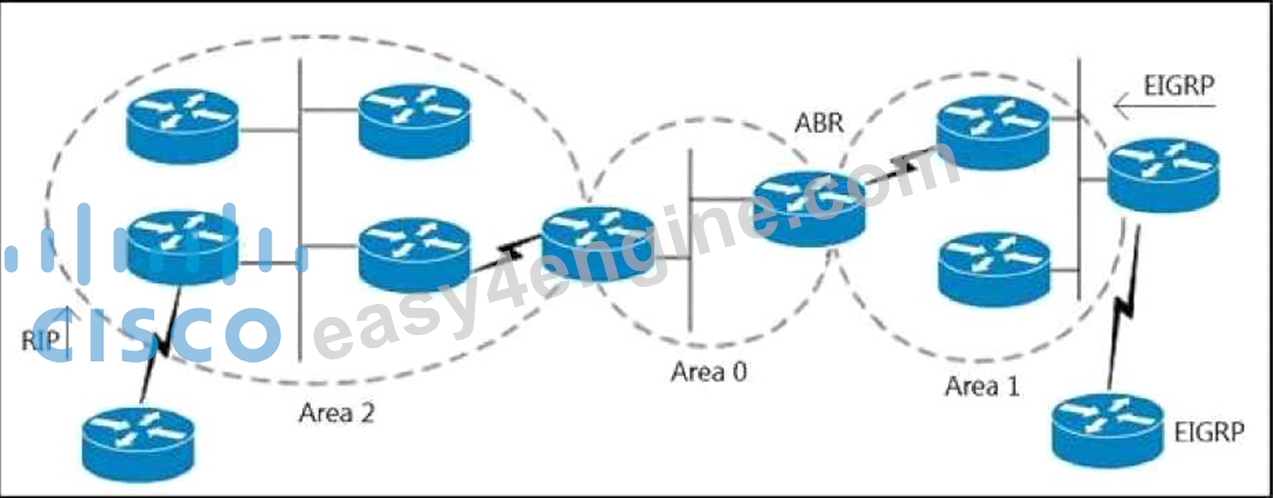
Refer to the exhibit. An engineer is designing an OSPF network for a client. Requirements dictate that the routers in Area 1 should receive all routes belonging to the network, including EIGRP, except the ones originated in the RIP domain. Which action should the engineer take?
- A. Make area 1 a stub.
- B. Make area 1 a NSSA.
- C. Make area 1 a standard OSPF area.
- D. Make the area 1 routers part of area 0.
Answer: B
Explanation: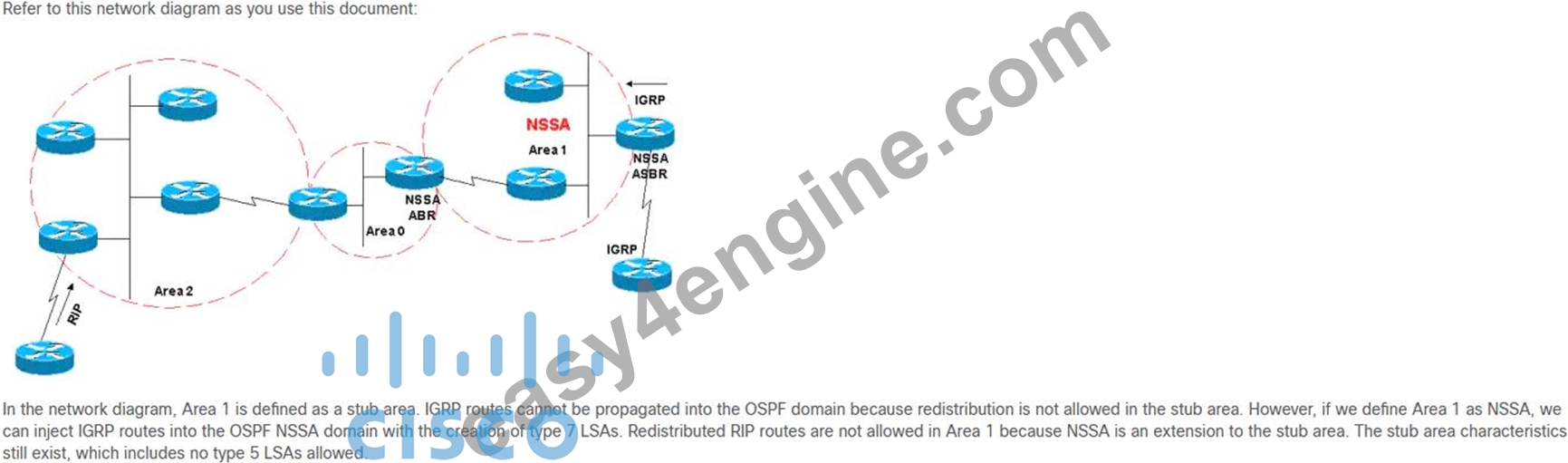
NEW QUESTION 39
Which technology provides a multichassis IP connection between VSS-enabled switches and downstream devices?
- A. LACP
- B. ICCP
- C. MEC
- D. LAG
- E. PAgP
- F. BFD
Answer: C
NEW QUESTION 40
An engineer must peer with an ISP for internet connectivity using BGP, initially, the engineer wants to receive only specific prefixes from the ISP and a default route. However, the solution must provide the flexibility to add prefixes in the future at short notice. The ISP has a two-week change process in place. Which route filtering solution must the engineer employ?
- A. Request a full internet routing table and a default route from the ISP and configure inbound route filtering with a prefix list that permits the default route and required prefixes
- B. Configure outbound route filtering on the enterprise and ISP so that the enterprise tell the ISP which prefixes are required
- C. Request only the required prefixes and default route be advertised from the ISO with whitelisted networks
- D. Request a limited internet routing table and a default route from the ISP and configure the BGP max-limit to 1 with an access list that permits only the specific internet prefixes and blocked networks
Answer: A
Explanation:
anychange on the prefix list, engineer only need to update the preifx list and restart the BGP peer to the ISP. soft-reconfiguration inbound could be used to reduce down time of reset BGP peer, but it require lots of memory and in this case, connection to ISP and tons of route learnt will not be apporitated.
NEW QUESTION 41
Which component is part of the Cisco SD-Access overlay architecture?
- A. Cisco DNA Center
- B. border node
- C. leaf node
- D. spine node
Answer: A
NEW QUESTION 42
A company needs to increase access port capacity on one floor of a building. They want to leverage the existing catalyst access switch. There is no problem with uplink bandwidth capacity. However, no additional uplinks can be added because no ports are available on the distribution switches. Which solution must the company choose to provide additional access ports?
- A. Stackwise
- B. VSS
- C. VDC
- D. Etherchannel
Answer: A
NEW QUESTION 43
Which command is needed to enable DHCP snooping if a switchport is connected to a DHCP server?
- A. ip dhcp snooping trust
- B. ip dhcp snooping
- C. ip dhcp trust
- D. ip dhcp snooping information
Answer: A
Explanation:
When configuring DHCP snooping, follow these guidelines:
DHCP snooping is not active until you enable the feature on at least one VLAN, and enable DHCP globally on the switch.
Before globally enabling DHCP snooping on the switch, make sure that the devices acting as the DHCP server and the DHCP relay agent are configured and enabled.
If a Layer 2 LAN port is connected to a DHCP server, configure the port as trusted by entering the "ip dhcp snooping trust" interface configuration command.
If a Layer 2 LAN port is connected to a DHCP client, configure the port as untrusted by entering the no ip dhcp snooping trust interface configuration command.
Reference: http://www.cisco.com/c/en/us/td/docs/switches/lan/catalyst6500/ios/12-2SX/configuration/guide/ book/snoodhcp.html
NEW QUESTION 44
Refer to the exhibit.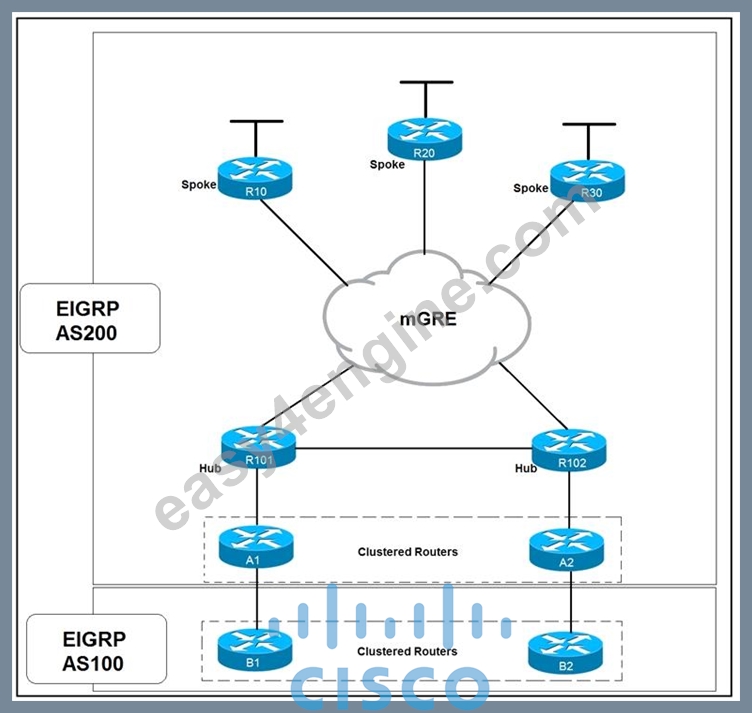
Which solution decreases the EIGRP convergence time?
- A. Enable subsecond timers
- B. Increase the hold time value
- C. Enable stub routing on the spokes
- D. Increase the dead timer value
Answer: C
NEW QUESTION 45
Refer to the exhibit. AS65533 and AS65530 are announcing a partial Internet routing table as well as their IP subnets. An architect must create a design that ensures AS64512 become a transit AS. Which filtering solution must the architect choose?
- A. Next-hop
- B. No-advertise
- C. Maximum-prefix
- D. No Export
Answer: C
NEW QUESTION 46
Drag and drop the elements from the left onto the YANG models where they and used on the right.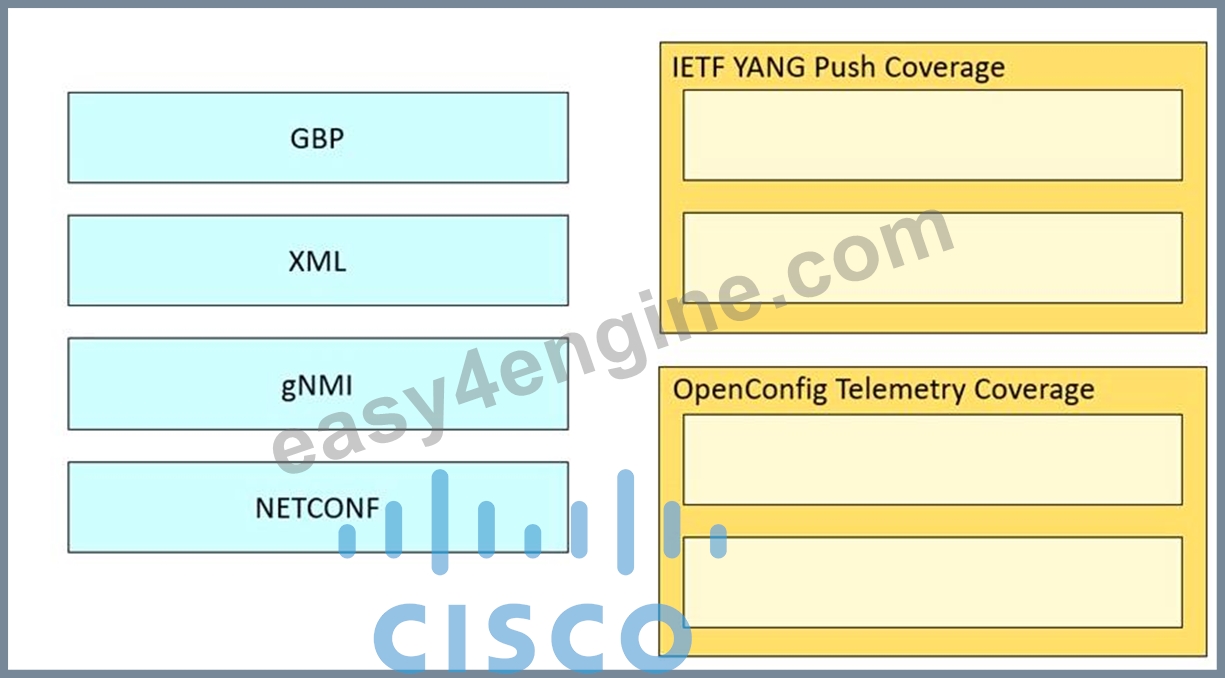
Answer:
Explanation: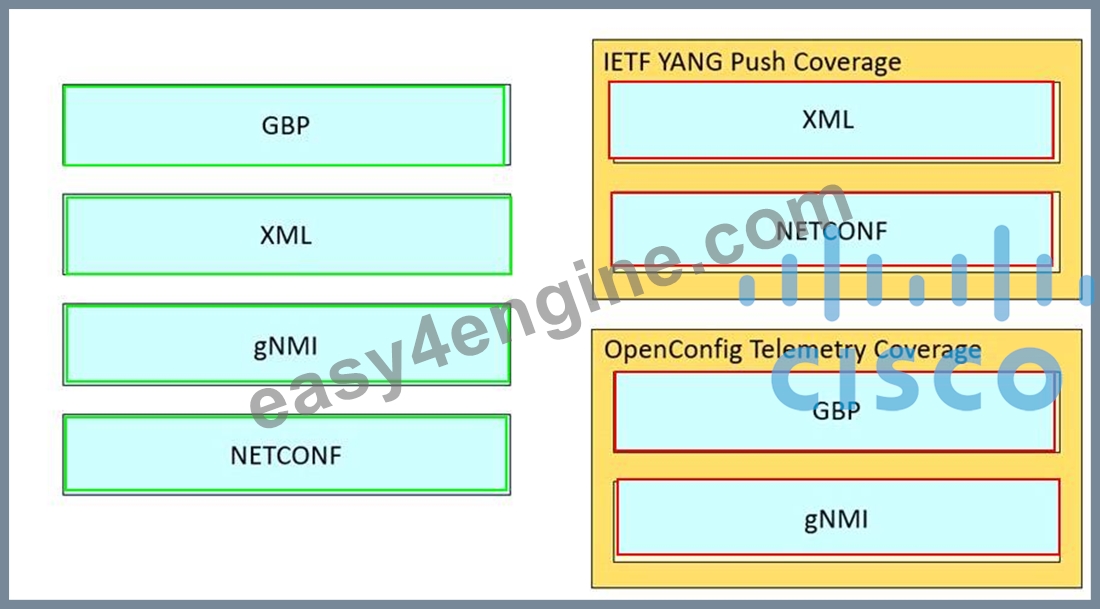
NEW QUESTION 47
Refer to the exhibit.
C0FD9F48 C9ACDC725EA850EC2476EE1E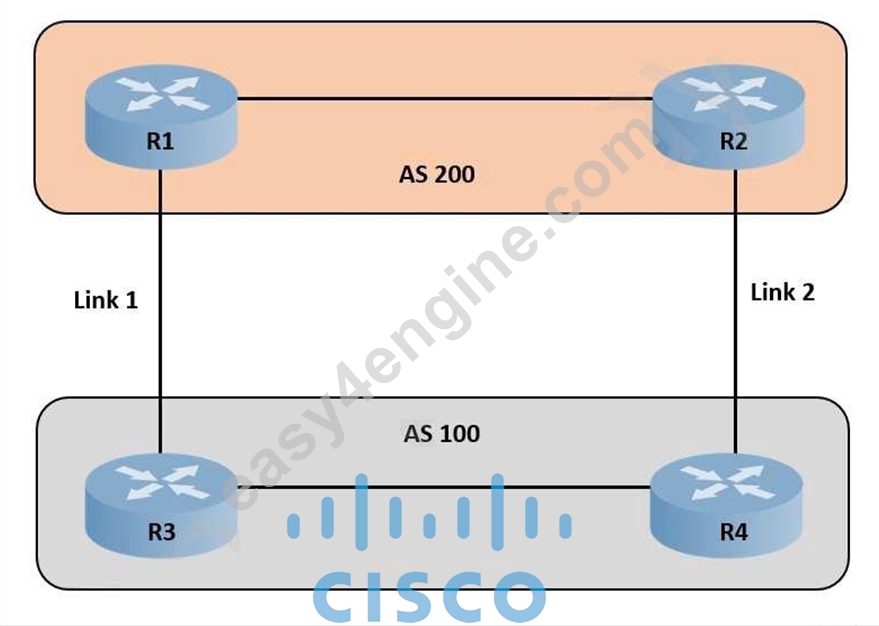
A network engineer is designing a network for AS100. The design should ensure that all traffic enters AS100 via link 1 unless there is a network failure. In the event of a failure, link 2 should function as the path for incoming traffic. Which solution should the design include?
- A. Modify the next-hop attribute on R3.
- B. Use AS-Path prepending on R4.
- C. Use AS-Path prepending on R3.
- D. Modify the next-hop attribute on R4.
Answer: B
NEW QUESTION 48
In what mode does an LWAPP-enabled access point operate?
- A. ad hoc mode
- B. autonomous mode
- C. lightweight mode
- D. WGB
Answer: C
Explanation:
Lightweight access point protocol (LWAPP)-enabled access points operate in lightweight mode. LWAPP is a protocol used to allow centralized management of APs. The management components are removed from the APs, and a WLAN controller provides a single point of management. This controller coordinates WLAN access, managing the load on the APs and user movement between APs. Upon starting, an LWAPP-enabled access point must obtain an IP address. It can then discover the controller using DHCP, DNS, or a subnet broadcast. When multiple wireless controllers are detected by an AP, it chooses to associate with the controller that has the fewest existing associated APs.
Individually configured APs that operate without central management are operating in autonomous mode. This would be the opposite of lightweight mode, which is made possible by LWAPP. Autonomous access points can be upgraded to lightweight. If they are upgraded, they will only function in conjunction with a WLAN controller.
Moreover, when an autonomous access point is upgraded to lightweight, the console port only provides read access to the unit.
Characteristics that autonomous and lightweight access points have in common:
Both support Power over Ethernet (PoE)
Both can use a Cisco Secure Access Control server (ACS) for security
A wireless gateway bridge (WGB) is used to connect a computer without a wireless network card to a wireless network, but not separate WLANs. The WGB can connect up to eight computers to a WLAN. The WGB connects to the root AP through a wireless interface.
Ad hoc is a WLAN mode used for peer-to-peer connectivity. Ad hoc mode allows wireless-enabled computers to communicate with each other without having an AP involved.
Objective:
Layer 2 Technologies
Sub-Objective:
Configure and verify other LAN switching technologies
References:
Cisco > Support > Product Support > Wireless > Cisco Aironet 1200 Series > Reference Guides > Technical References > Upgrading Autonomous Cisco Aironet Access Points to Lightweight Mode Cisco > Support > Technology Support > Wireless/Mobility > Wireless, LAN (WLAN) > Design > Design Technotes > Cisco Wireless Devices Association Matrix
NEW QUESTION 49
An architect must design an IPv6 migration solution for a corporation with remote offices to support:
* The customer has IPv4 peering with their service provider.
* IPv6 users need access to IPv4 and IPv6 resources.
* Existing content providers will migrate to IPv6 in the next two years.
* Users will be migrated in a phase-by-phase approach.
Which migration solution must the architect choose?
- A. dual-stack
- B. NAT64
- C. tunneling
- D. NAT46
Answer: A
NEW QUESTION 50
An engineer must design an addressing plan for a small business using a single /24 network. Each department must have its own subnet. Drag and drop the subnets from the left onto the departments requirements that they fulfill on the right. Not all options are used.
Answer:
Explanation: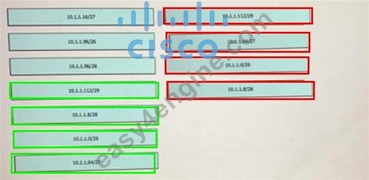
NEW QUESTION 51
Which consideration must be taken into account when using the DHCP relay feature in a Cisco SD-Access Architecture?
- A. A DHCP server must be enabled on the border nodes to allow subnets to span multiple fabric edges.
- B. DHCP Option-82 must be enabled to map the circuit IP option to the access fabric node where the DHCP discover originated.
- C. DHCP servers must support Cisco SD-Access extensions to correctly assign IPs to endpoints in an SDAccess fabric with anycast gateway.
- D. DHCP-relay must be enabled on fabric edge nodes to provide the correct mapping of DHCP scope to the local anycast gateway.
Answer: D
NEW QUESTION 52
An engineer must design a VPN solution for a company that has multiple branches connecting to a main office.
What are two advantages of using DMVPN instead of IPsec tunnels to accomplish this task? (Choose two.)
- A. lower traffic overhead
- B. support for anycast gateway
- C. greater scalability
- D. support for AES 256-bit encryption
- E. dynamic spoke-to-spoke tunnels
Answer: C,E
Explanation:
Section: WAN for Enterprise Networks
NEW QUESTION 53
Drag and drop the model driven telemetry characteristics from the left onto the mode they belong to on the right.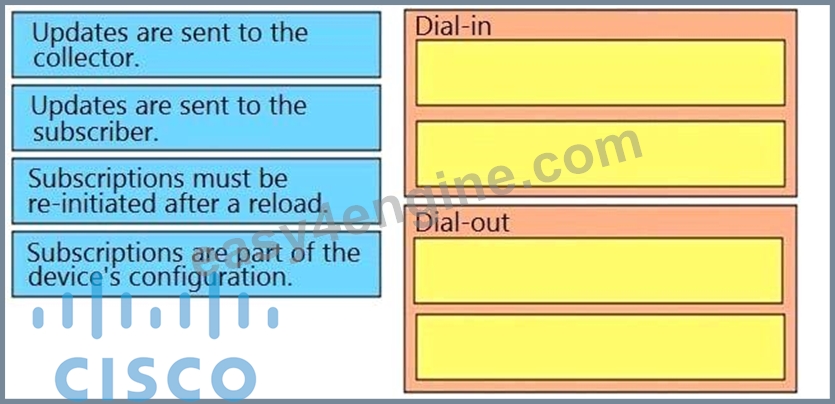
Answer:
Explanation: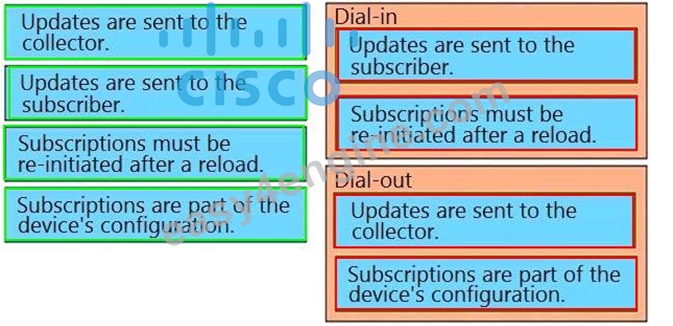
NEW QUESTION 54
Drag and drop the properties from the left onto the protocols they describe on the right.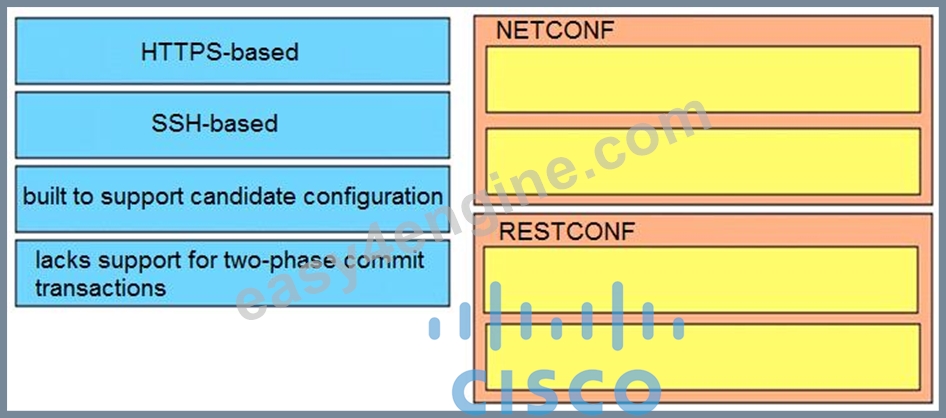
Answer:
Explanation: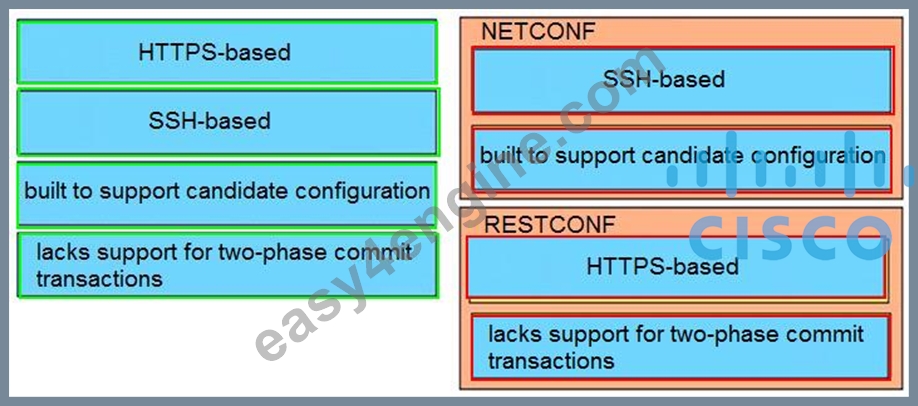
Reference:
https://www.cisco.com/c/en/us/td/docs/ios-xml/ios/prog/configuration/166/b_166_programmability_cg/ b_166_programmability_cg_chapter_01011.html
https://www.cisco.com/c/en/us/td/docs/ios-xml/ios/prog/configuration/169/b_169_programmability_cg/ configuring_yang_datamodel.html
NEW QUESTION 55
An infrastructure team is concerned about the shared memory utilization of a device, and for this reason, they need to monitor the device state. Which solution limits impact on the device and provides the required data?
- A. static telemetry
- B. IPFIX
- C. on-change subscription
- D. periodic subscription
Answer: C
Explanation:
There are two types of subscriptions: periodic and on-change. With periodic subscription, data is streamed out to the destination at the configured interval. It continuously sends data for the lifetime of that subscription. With on-change, data is published only when a change in the data occurs such as when an interface or OSPF neighbor goes down. https://developer.cisco.com/docs/ios-xe/#!streaming-telemetry-quick-start-guide/streaming-telemetry
NEW QUESTION 56
......
Resources From:
- 2023 Latest Easy4Engine 300-420 Exam Dumps (PDF & Exam Engine) Free Share: https://www.easy4engine.com/300-420-test-engine.html
- 2023 Latest Easy4Engine 300-420 PDF and 300-420 Exam Dumps Free Share: https://drive.google.com/open?id=1wVLpPVM2hJmCmiAihjiapJusc_5V346f
Free Resources from Easy4Engine, We Devoted to Helping You 100% Pass All Exams!
