

[Jan 11, 2024] New Updated DP-300 Exam Questions 2024
Updated Free Microsoft DP-300 Test Engine Questions with 290 Q&As
NEW QUESTION # 170
You have an Azure Databricks resource.
You need to log actions that relate to changes in compute for the Databricks resource.
Which Databricks services should you log?
- A. DBFS
- B. jobs
- C. SSH
- D. clusters
- E. workspace
Answer: E
Explanation:
Cloud Provider Infrastructure Logs.
Databricks logging allows security and admin teams to demonstrate conformance to data governance
standards within or from a Databricks workspace. Customers, especially in the regulated industries, also need records on activities like:
User access control to cloud data storage
Cloud Identity and Access Management roles
User access to cloud network and compute
Azure Databricks offers three distinct workloads on several VM Instances tailored for your data analytics workflow-the Jobs Compute and Jobs Light Compute workloads make it easy for data engineers to build and execute jobs, and the All-Purpose Compute workload makes it easy for data scientists to explore, visualize, manipulate, and share data and insights interactively.
Reference:
https://databricks.com/blog/2020/03/25/trust-but-verify-with-databricks.html
NEW QUESTION # 171
You have an Azure Data Lake Storage Gen2 account named account1 that stores logs as shown in the following table.
You do not expect that the logs will be accessed during the retention periods.
You need to recommend a solution for account1 that meets the following requirements:
Automatically deletes the logs at the end of each retention period
Minimizes storage costs
What should you include in the recommendation? To answer, select the appropriate options in the answer area.
NOTE: Each correct selection is worth one point.
Answer:
Explanation:
Reference:
https://docs.microsoft.com/en-us/azure/storage/blobs/storage-blob-storage-tiers
NEW QUESTION # 172
You have an Azure SQL logical server.
You run the following script.

Answer:
Explanation:
NEW QUESTION # 173
You have an Azure SQL database named db1 on a server named server1.
The Intelligent Insights diagnostics log identifies that several tables are missing indexes.
You need to ensure that indexes are created for the tables.
What should you do?
- A. Modify the automatic tuning settings for db1.
- B. RuntheDBCC SQLPERF command.
- C. Modify the Query Store settings for db1.
- D. Run the dbcc dbreindex command.
Answer: A
Explanation:
Reference:
https://docs.microsoft.com/en-us/azure/azure-sql/database/automatic-tuning-overview
NEW QUESTION # 174
You create a new Azure SQL managed instance named SQL1 and enable Database Mail extended stored You need to ensure that SQ Server Agent jobs running on SQL 1 can notify when a failure Occurs Which three actions should you perform in sequence 7 TO answer. move the appropriate actions from the list Of actions to answer area and arrange them in correct order.
Answer:
Explanation:
1 - Create Database Mail account.
2 - Create a pfofile named AzureManagedInstance_dbmail_pfofile.
3 - Enable email notifications upon failure.
NEW QUESTION # 175
You have an Azure SQL database named DB1.
You need to ensure that DB1 will support automatic failover without data loss if a datacenter fails. The solution must minimize costs.
Which deployment option and pricing tier should you configure?
- A. Azure SQL Database managed instance Business Critical
- B. Azure SQL Database Standard
- C. Azure SQL Database serverless
- D. Azure SQL Database Premium
- E. This feature is not available in SQL Managed Instance.
Answer: D
Explanation:
By default, the cluster of nodes for the premium availability model is created in the same datacenter. With the introduction of Azure Availability Zones, SQL Database can place different replicas of the Business Critical database to different availability zones in the same region. To eliminate a single point of failure, the control ring is also duplicated across multiple zones as three gateway rings (GW). The routing to a specific gateway ring is controlled by Azure Traffic Manager (ATM). Because the zone redundant configuration in the Premium or Business Critical service tiers does not create additional database redundancy, you can enable it at no extra cost. By selecting a zone redundant configuration, you can make your Premium or Business Critical databases resilient to a much larger set of failures, including catastrophic datacenter outages, without any changes to the application logic. You can also convert any existing Premium or Business Critical databases or pools to the zone redundant configuration.
Reference:
https://docs.microsoft.com/en-us/azure/azure-sql/database/high-availability-sla
Topic 1, Contoso Ltd
To start the case study
This is a case study. Case studies are not timed separately. You can use as much exam time as you would like to complete each case. However, there may be additional case studies and sections on this exam. You must manage your time to ensure that you are able to complete all questions included on this exam in the time provided.
To answer the questions included in a case study, you will need to reference information that is provided in the case study. Case studies might contain exhibits and other resources that provide more information about the scenario that is described in the case study. Each question is independent of the other questions in this case study.
At the end of this case study, a review screen will appear. This screen allows you to review your answers and to make changes before you move to the next section of the exam. After you begin a new section, you cannot return to this section.
To display the first question in this case study, click the Next button. Use the buttons in the left pane to explore the content of the case study before you answer the questions. Clicking these buttons displays information such as business requirements, existing environment, and problem statements. If the case study has an All Information tab, note that the information displayed is identical to the information displayed on the subsequent tabs. When you are ready to answer a question, click the Question button to return to the question.
Overview
Existing Environment
Contoso, Ltd. is a financial data company that has 100 employees. The company delivers financial data to customers.
Active Directory
Contoso has a hybrid Azure Active Directory (Azure AD) deployment that syncs to on-premises Active Directory.
Database Environment
Contoso has SQL Server 2017 on Azure virtual machines shown in the following table.
SQL1 and SQL2 are in an Always On availability group and are actively queried. SQL3 runs jobs, provides historical data, and handles the delivery of data to customers.
The on-premises datacenter contains a PostgreSQL server that has a 50-TB database.
Current Business Model
Contoso uses Microsoft SQL Server Integration Services (SSIS) to create flat files for customers. The customers receive the files by using FTP.
Requirements
Planned Changes
Contoso plans to move to a model in which they deliver data to customer databases that run as platform as a service (PaaS) offerings. When a customer establishes a service agreement with Contoso, a separate resource group that contains an Azure SQL database will be provisioned for the customer. The database will have a complete copy of the financial data. The data to which each customer will have access will depend on the service agreement tier. The customers can change tiers by changing their service agreement.
The estimated size of each PaaS database is 1 TB.
Contoso plans to implement the following changes:
Business Goals
Contoso identifies the following business requirements:
Technical Requirements
Contoso identifies the following technical requirements:
Monitoring Requirements
Contoso identifies the following monitoring requirements:
PaaS Prototype
During prototyping of the PaaS solution in Azure, you record the compute utilization of a customer's Azure SQL database as shown in the following exhibit.
Role Assignments
For each customer's Azure SQL Database server, you plan to assign the roles shown in the following exhibit.
NEW QUESTION # 176
You are planning the migration of the SERVER1 databases. The solution must meet the business requirements.
What should you include in the migration plan? To answer, select the appropriate options in the answer area.
NOTE: Each correct selection is worth one point.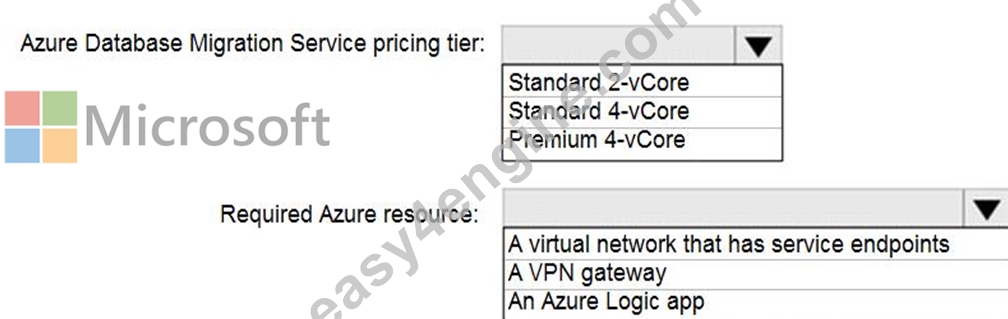
Answer:
Explanation:
Reference:
https://azure.microsoft.com/pricing/details/database-migration/
https://docs.microsoft.com/en-us/azure/dms/tutorial-sql-server-azure-sql-online
NEW QUESTION # 177
You have an Azure Data Factory instance named ADF1 and two Azure Synapse Analytics workspaces named WS1 and WS2.
ADF1 contains the following pipelines:
P1:Uses a copy activity to copy data from a nonpartitioned table in a dedicated SQL pool of WS1 to an Azure Data Lake Storage Gen2 account P2:Uses a copy activity to copy data from text-delimited files in an Azure Data Lake Storage Gen2 account to a nonpartitioned table in a dedicated SQL pool of WS2 You need to configure P1 and P2 to maximize parallelism and performance.
Which dataset settings should you configure for the copy activity of each pipeline? To answer, select the appropriate options in the answer area.
Answer:
Explanation: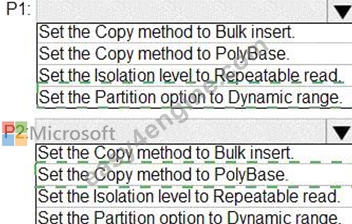
Explanation
Graphical user interface, text, chat or text message Description automatically generated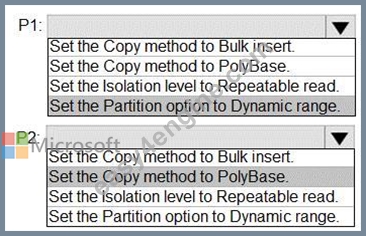
P1: Set the Partition option to Dynamic Range.
The SQL Server connector in copy activity provides built-in data partitioning to copy data in parallel.
P2: Set the Copy method to PolyBase
Polybase is the most efficient way to move data into Azure Synapse Analytics. Use the staging blob feature to achieve high load speeds from all types of data stores, including Azure Blob storage and Data Lake Store.
(Polybase supports Azure Blob storage and Azure Data Lake Store by default.) Reference:
https://docs.microsoft.com/en-us/azure/data-factory/connector-azure-sql-data-warehouse
https://docs.microsoft.com/en-us/azure/data-factory/load-azure-sql-data-warehouse
NEW QUESTION # 178
You configure backup for an Azure SQL database as shown in the following exhibit.
Use the drop-down menus to select the answer choice the completes each statement based on the information presented in the graphic.
NOTE: Each correct selection is worth one point.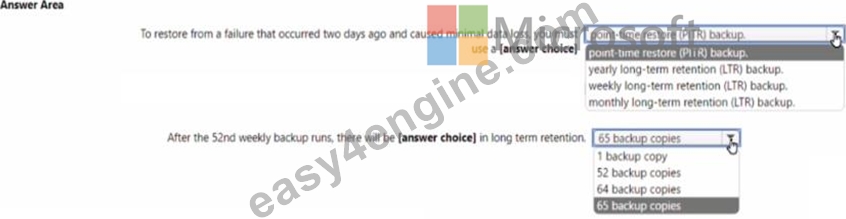
Answer:
Explanation:
NEW QUESTION # 179
Note: This question is part of a series of questions that present the same scenario. Each question in the series contains a unique solution that might meet the stated goals. Some question sets might have more than one correct solution, while others might not have a correct solution.
After you answer a question in this section, you will NOT be able to return to it. As a result, these questions will not appear in the review screen.
You have an Azure SQL database named Sales.
You need to implement disaster recovery for Sales to meet the following requirements:
* During normal operations, provide at least two readable copies of Sales.
* Ensure that Sales remains available if a datacenter fails.
Solution: You deploy an Azure SQL database that uses the General Purpose service tier and geo-replication.
Does this meet the goal?
- A. Yes
- B. No
Answer: B
Explanation:
Instead deploy an Azure SQL database that uses the Business Critical service tier and Availability Zones.
Note: Premium and Business Critical service tiers leverage the Premium availability model, which integrates compute resources (sqlservr.exe process) and storage (locally attached SSD) on a single node. High availability is achieved by replicating both compute and storage to additional nodes creating a three to four- node cluster.
By default, the cluster of nodes for the premium availability model is created in the same datacenter. With the introduction of Azure Availability Zones, SQL Database can place different replicas of the Business Critical database to different availability zones in the same region. To eliminate a single point of failure, the control ring is also duplicated across multiple zones as three gateway rings (GW).
Reference:
https://docs.microsoft.com/en-us/azure/azure-sql/database/high-availability-sla Perform Administration by Using T-SQL Testlet 1 This is a case study. Case studies are not timed separately. You can use as much exam time as you would like to complete each case. However, there may be additional case studies and sections on this exam. You must manage your time to ensure that you are able to complete all questions included on this exam in the time provided.
To answer the questions included in a case study, you will need to reference information that is provided in the case study. Case studies might contain exhibits and other resources that provide more information about the scenario that is described in the case study. Each question is independent of the other questions in this case study.
At the end of this case study, a review screen will appear. This screen allows you to review your answers and to make changes before you move to the next section of the exam. After you begin a new section, you cannot return to this section.
To start the case study
To display the first question in this case study, click the Next button. Use the buttons in the left pane to explore the content of the case study before you answer the questions. Clicking these buttons displays information such as business requirements, existing environment, and problem statements. If the case study has an All Information tab, note that the information displayed is identical to the information displayed on the subsequent tabs. When you are ready to answer a question, click the Question button to return to the question.
Existing Environment
Network Environment
The manufacturing and research datacenters connect to the primary datacenter by using a VPN.
The primary datacenter has an ExpressRoute connection that uses both Microsoft peering and private peering.
The private peering connects to an Azure virtual network named HubVNet.
Identity Environment
Litware has a hybrid Azure Active Directory (Azure AD) deployment that uses a domain named litwareinc.com.
All Azure subscriptions are associated to the litwareinc.com Azure AD tenant.
Database Environment
The sales department has the following database workload:
* An on-premises named SERVER1 hosts an instance of Microsoft SQL Server 2012 and two 1-TB databases.
* A logical server named SalesSrv01A contains a geo-replicated Azure SQL database named SalesSQLDb1.
SalesSQLDb1 is in an elastic pool named SalesSQLDb1Pool. SalesSQLDb1 uses database firewall rules and contained database users.
* An application named SalesSQLDb1App1 uses SalesSQLDb1.
The manufacturing office contains two on-premises SQL Server 2016 servers named SERVER2 and SERVER3. The servers are nodes in the same Always On availability group. The availability group contains a database named ManufacturingSQLDb1 Database administrators have two Azure virtual machines in HubVnet named VM1 and VM2 that run Windows Server 2019 and are used to manage all the Azure databases.
Licensing Agreement
Litware is a Microsoft Volume Licensing customer that has License Mobility through Software Assurance.
Current Problems
SalesSQLDb1 experiences performance issues that are likely due to out-of-date statistics and frequent blocking queries.
Requirements
Planned Changes
Litware plans to implement the following changes:
* Implement 30 new databases in Azure, which will be used by time-sensitive manufacturing apps that have varying usage patterns. Each database will be approximately 20 GB.
* Create a new Azure SQL database named ResearchDB1 on a logical server named ResearchSrv01.
ResearchDB1 will contain Personally Identifiable Information (PII) data.
* Develop an app named ResearchApp1 that will be used by the research department to populate and access ResearchDB1.
* Migrate ManufacturingSQLDb1 to the Azure virtual machine platform.
* Migrate the SERVER1 databases to the Azure SQL Database platform.
Technical Requirements
Litware identifies the following technical requirements:
* Maintenance tasks must be automated.
* The 30 new databases must scale automatically.
* The use of an on-premises infrastructure must be minimized.
* Azure Hybrid Use Benefits must be leveraged for Azure SQL Database deployments.
* All SQL Server and Azure SQL Database metrics related to CPU and storage usage and limits must be analyzed by using Azure built-in functionality.
Security and Compliance Requirements
Litware identifies the following security and compliance requirements:
* Store encryption keys in Azure Key Vault.
* Retain backups of the PII data for two months.
* Encrypt the PII data at rest, in transit, and in use.
* Use the principle of least privilege whenever possible.
* Authenticate database users by using Active Directory credentials.
* Protect Azure SQL Database instances by using database-level firewall rules.
* Ensure that all databases hosted in Azure are accessible from VM1 and VM2 without relying on public endpoints.
Business Requirements
Litware identifies the following business requirements:
* Meet an SLA of 99.99% availability for all Azure deployments.
* Minimize downtime during the migration of the SERVER1 databases.
* Use the Azure Hybrid Use Benefits when migrating workloads to Azure.
* Once all requirements are met, minimize costs whenever possible.
NEW QUESTION # 180
You plan to create a table in an Azure Synapse Analytics dedicated SQL pool.
Data in the table will be retained for five years. Once a year, data that is older than five years will be deleted.
You need to ensure that the data is distributed evenly across partitions. The solutions must minimize the amount of time required to delete old data.
How should you complete the Transact-SQL statement? To answer, drag the appropriate values to the correct targets. Each value may be used once, more than once, or not at all.
You may need to drag the split bar between panes or scroll to view content.
NOTE: Each correct selection is worth one point.
Answer:
Explanation: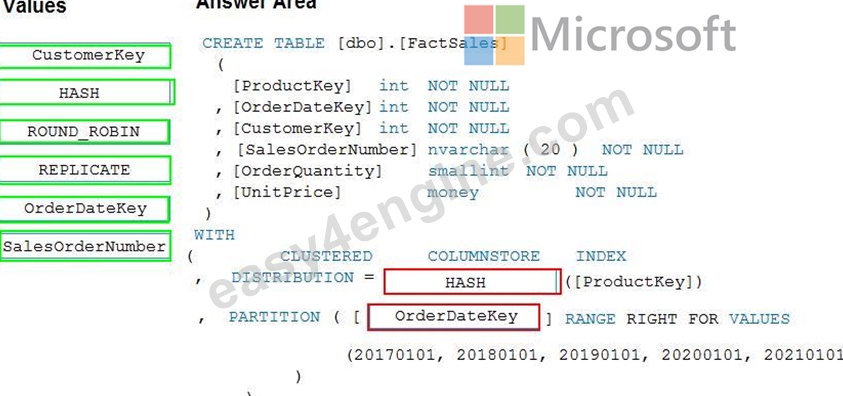
Reference:
https://docs.microsoft.com/en-us/sql/t-sql/statements/create-table-azure-sql-data-warehouse
https://docs.microsoft.com/en-us/azure/synapse-analytics/sql/best-practices-dedicated-sql-pool
NEW QUESTION # 181
You have an Azure SQL database named db1 that contains an Azure Active Directory (Azure AD) user named user1.
You need to test impersonation of user1 in db1 by running aSELECTstatement and returning to the original execution context.
How should you complete the Transact-SQL statement? To answer, select the appropriate options in the answer area.
NOTE:Each correct selection is worth one point.
Answer:
Explanation: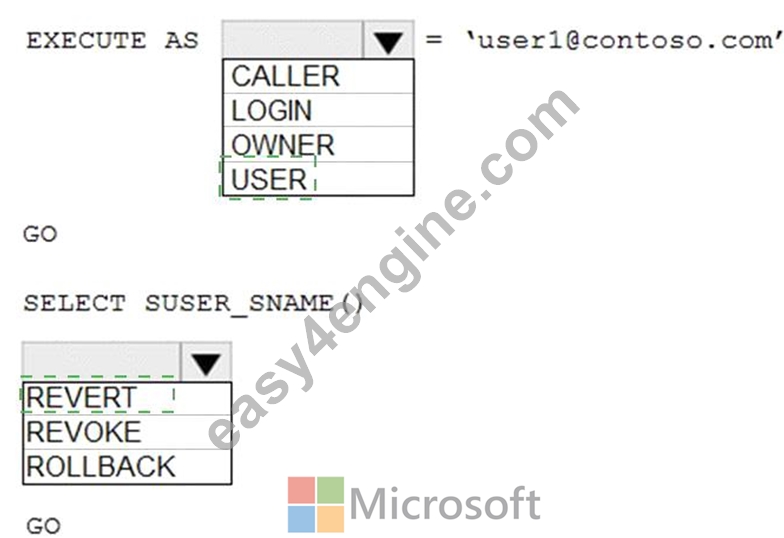
Explanation
Graphical user interface Description automatically generated
Reference:
https://docs.microsoft.com/en-us/sql/t-sql/statements/execute-as-transact-sql?view=sql-server-ver15
https://docs.microsoft.com/en-us/sql/t-sql/functions/suser-sname-transact-sql?view=sql-server-ver15
NEW QUESTION # 182
You have an Azure SQL database that contains a table named factSales. FactSales contains the columns shown in the following table.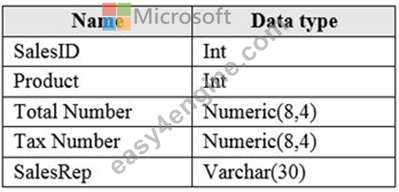
FactSales has 6 billion rows and is loaded nightly by using a batch process.
Which type of compression provides the greatest space reduction for the database?
- A. page compression
- B. row compression
- C. columnstore archival compression
- D. columnstore compression
Answer: C
Explanation:
Explanation
Columnstore tables and indexes are always stored with columnstore compression. You can further reduce the size of columnstore data by configuring an additional compression called archival compression.
Note: Columnstore - The columnstore index is also logically organized as a table with rows and columns, but the data is physically stored in a column-wise data format.
Reference:
https://docs.microsoft.com/en-us/sql/relational-databases/data-compression/data-compression
NEW QUESTION # 183
You are planning disaster recovery for the failover group of an Azure SQL Database managed instance.
Your company's SLA requires that the database in the failover group become available as quickly as possible if a major outage occurs.
You set the Read/Write failover policy to Automatic.
What are two results of the configuration? Each correct answer presents a complete solution.
NOTE: Each correct selection is worth one point.
- A. In the event of an outage, the minimum delay for the databases to fail over in the primary instance will be one hour.
- B. In the event of an outage, you can selectively fail over individual databases.
- C. In the event of an outage, the databases in the primary instance will fail over immediately.
- D. In the event of a datacenter or Azure regional outage, the databases will fail over automatically.
- E. In the event of an outage, you can set a different grace period to fail over each database.
Answer: A,D
Explanation:
A: Auto-failover groups allow you to manage replication and failover of a group of databases on a server or all databases in a managed instance to another region.
E: Because verification of the scale of the outage and how quickly it can be mitigated involves human actions by the operations team, the grace period cannot be set below one hour. This limitation applies to all databases in the failover group regardless of their data synchronization state.
Incorrect Answers:
C: individual SQL Managed Instance databases cannot be added to or removed from a failover group.
Reference:
https://docs.microsoft.com/en-us/azure/azure-sql/database/auto-failover-group-overview
NEW QUESTION # 184
You need to recommend an availability strategy for an Azure SQL database. The strategy must meet the
following requirements:
Support failovers that do not require client applications to change their connection strings.
Replicate the database to a secondary Azure region.
Support failover to the secondary region.
What should you include in the recommendation?
- A. failover groups
- B. Availability Zones
- C. geo-replication
- D. transactional replication
Answer: C
Explanation:
Active geo-replication is an Azure SQL Database feature that allows you to create readable secondary databases of individual databases on a server in the same or different data center (region).
Incorrect Answers:
C: Availability Zones are unique physical locations within a region. Each zone is made up of one or more
datacenters equipped with independent power, cooling, and networking.
Reference:
https://docs.microsoft.com/en-us/azure/azure-sql/database/active-geo-replication-overview
NEW QUESTION # 185
You have an Azure subscription that contains a server named Server1. Server1 hosts two Azure SQL databases named DB1 and DB2.
You plan to deploy a Windows app named App1 that will authenticate to DB2 by using SQL authentication.
You need to ensure that App1 can access DB2. The solution must meet the following requirements:
App1 must be able to view only DB2.
Administrative effort must be minimized.
What should you create?
- A. a login for App1 on Server1
- B. a contained database user from a Windows login for App1 on DB2
- C. a contained database user from an external provider for App1 on DB2
- D. a contained database user for App1 on DB2
Answer: B
Explanation:
Reference:
https://docs.microsoft.com/en-us/sql/relational-databases/security/contained-database-users-making-your-database-portable?view=sql-server-ver15
NEW QUESTION # 186
You have the following Azure Resource Manager template.
For each of the following statements, select Yes if the statement is true. Otherwise, select No.
NOTE: Each correct selection is worth one point.
Answer:
Explanation:
Explanation
A screenshot of a computer Description automatically generated with low confidence
Reference:
https://docs.microsoft.com/en-us/azure/azure-sql/database/purchasing-models
https://docs.microsoft.com/en-us/azure/azure-sql/database/single-database-create-arm-template-quickstart
NEW QUESTION # 187
You have an Azure SQL database named DB3.
You need to provide a user named DevUser with the ability to view the properties of DB3 from Microsoft SQL Server Management Studio (SSMS) as shown in the exhibit. (Click the Exhibit tab.)
Which Transact-SQL command should you run?
- A. GRANT SHOWPLAN TO DevUser
- B. GRANT VIEW DATABASE STATE TO DevUser
- C. GRANT VIEW DEFINITION TO DevUser
- D. GRANT SELECT TO DevUser
Answer: B
Explanation:
Explanation
The exhibits displays Database [State] properties.
To query a dynamic management view or function requires SELECT permission on object and VIEW SERVER STATE or VIEW DATABASE STATE permission.
Reference:
https://docs.microsoft.com/en-us/sql/relational-databases/databases/database-properties-options-page
NEW QUESTION # 188
You need to implement authentication for ResearchDB1. The solution must meet the security and compliance requirements.
What should you run as part of the implementation?
- A. CREATE USER and the FROM EXTERNAL PROVIDER clause
- B. CREATE USER and the FROM CERTIFICATE clause
- C. CREATE USER and the FROM LOGIN clause
- D. CREATE USER and the ASYMMETRIC KEY clause
- E. CREATE LOGIN and the FROM WINDOWS clause
Answer: A
Explanation:
Scenario: Authenticate database users by using Active Directory credentials.
(Create a new Azure SQL database named ResearchDB1 on a logical server named ResearchSrv01.) Authenticate the user in SQL Database or SQL Data Warehouse based on an Azure Active Directory user:
CREATE USER [[email protected]] FROM EXTERNAL PROVIDER;
Reference:
https://docs.microsoft.com/en-us/sql/t-sql/statements/create-user-transact-sql
NEW QUESTION # 189
You are performing exploratory analysis of bus fare data in an Azure Data Lake Storage Gen2 account by using an Azure Synapse Analytics serverless SQL pool.
You execute the Transact-SQL query shown in the following exhibit.
Use the drop-down menus to select the answer choice that completes each statement based on the information presented in the graphic.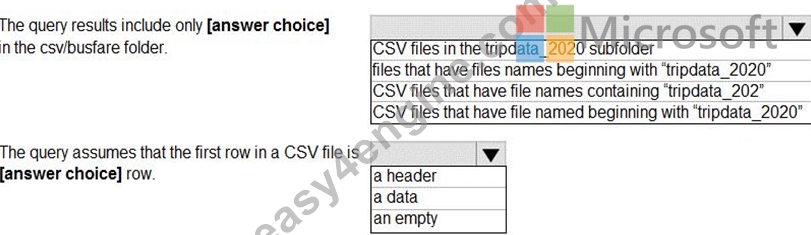
Answer:
Explanation: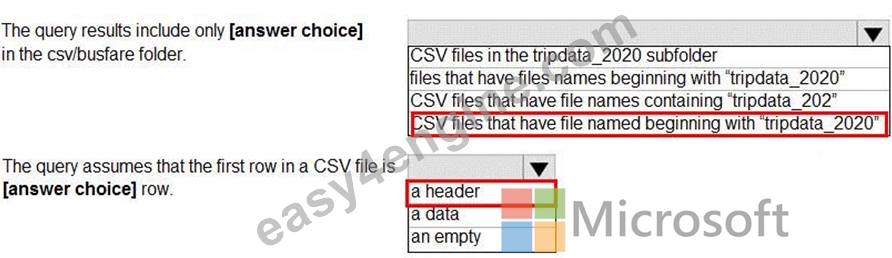
Reference:
https://docs.microsoft.com/en-us/azure/synapse-analytics/sql/develop-openrowset
NEW QUESTION # 190
You have 10 Azure virtual machines that have SQL Server installed.
You need to implement a backup strategy to ensure that you can restore specific databases to other SQL Server instances. The solution must provide centralized management of the backups.
What should you include in the backup strategy?
- A. Azure Backup
- B. Azure Site Recovery
- C. Automated Backup in the SQL virtual machine settings
- D. SQL Server Agent jobs
Answer: A
Explanation:
Explanation
Azure Backup provides an Enterprise class backup capability for SQL Server on Azure VMs. All backups are stored and managed in a Recovery Services vault. There are several advantages that this solution provides, especially for Enterprises.
Reference:
https://docs.microsoft.com/en-us/azure/azure-sql/virtual-machines/windows/backup-restore#azbackup
NEW QUESTION # 191
......
Exam Topics
The Microsoft DP-300 exam measures the capability of the candidates to complete certain technical tasks, such as querying performance, planning and implementing the High Availability & Disaster Recovery environment, and optimizing & monitoring operational resources. The highlights of these topics are as follows:
- Tasks Automation Performance: 10-15%
The examinees should have the capacity to develop scheduled tasks, measure and execute notification and alert strategies, and automate and manage tasks within Azure. This part will test their skills in managing schedules for different maintenance jobs, automating backups, and creating alerts for the server configuration changes.
- Data Platform Resources Planning and Implementation: 15-20%
The applicants should have the ability to deploy resources with the use of manual methods. They should also be able to recommend the relevant database contributions based on certain prerequisites. The examinees will be measured based on their competence in configuring resources for performance and scale; evaluating strategies for movement to Azure. They also need the knowledge of upgrade or migration strategy implementation to move to Azure.
- Query Performance Optimization: 5-10%
This knowledge area of the exam will test the ability of the students to evaluate performance optimization, evaluate query plans, and review index design and database table. This covers their competence in identifying issues with data quality based on duplication of data; evaluating a strategy for table partitioning; evaluating index design for optimal performance.
- HADR Planning and Implementation: 15-20%
This domain requires that the candidates have the ability to recommend High Availability & Disaster Recovery (HADR) strategies for data platform solutions. It also covers the skills in testing HADR strategies with the use of database tools, platforms, and operating systems. The subject area will also evaluate one’s expertise in performing the backup and restoration of a database with the use of database tools. It will also measure the ability to configure High Availability & Disaster Recovery with the use of platform, database tools, and OS.
The DP-300 certification exam covers a wide range of topics related to database administration, including designing and implementing database solutions on Azure, managing and monitoring databases, ensuring database security, and performing backups and restores. It also covers advanced topics such as designing for high availability and disaster recovery, implementing Azure SQL Database features, and managing Azure Synapse Analytics.
Try 100% Updated DP-300 Exam Questions [2024]: https://www.easy4engine.com/DP-300-test-engine.html
The Best Microsoft Azure DP-300 Professional Exam Questions: https://drive.google.com/open?id=1gZqoKoNYKGNr9rL_nJiXjKAfwrJiQd8A
