

[Mar 30, 2024] Uplift Your Professional-Cloud-DevOps-Engineer Exam Marks With The Help of Professional-Cloud-DevOps-Engineer Dumps
Use Google Professional-Cloud-DevOps-Engineer Dumps To Succeed Instantly in Professional-Cloud-DevOps-Engineer Exam
NEW QUESTION # 98
You manage an application that is writing logs to Stackdriver Logging. You need to give some team members the ability to export logs. What should you do?
- A. Create and grant a custom IAM role with the permissions logging.sinks.list and logging.sink.get.
- B. Create an Organizational Policy in Cloud IAM to allow only these members to create log exports.
- C. Grant the team members the IAM role of logging.configWriter on Cloud IAM.
- D. Configure Access Context Manager to allow only these members to export logs.
Answer: C
NEW QUESTION # 99
You are the on-call Site Reliability Engineer for a microservice that is deployed to a Google Kubernetes Engine (GKE) Autopilot cluster. Your company runs an online store that publishes order messages to Pub/Sub and a microservice receives these messages and updates stock information in the warehousing system. A sales event caused an increase in orders, and the stock information is not being updated quickly enough. This is causing a large number of orders to be accepted for products that are out of stock You check the metrics for the microservice and compare them to typical levels.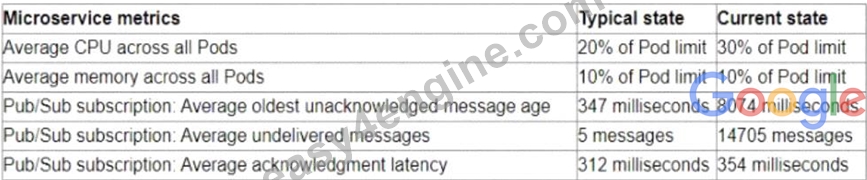
You need to ensure that the warehouse system accurately reflects product inventory at the time orders are placed and minimize the impact on customers What should you do?
- A. Increase the Pod CPU and memory limits
- B. Decrease the acknowledgment deadline on the subscription
- C. Add a virtual queue to the online store that allows typical traffic levels
- D. Increase the number of Pod replicas
Answer: D
Explanation:
Explanation
The best option for ensuring that the warehouse system accurately reflects product inventory at the time orders are placed and minimizing the impact on customers is to increase the number of Pod replicas. Increasing the number of Pod replicas will increase the scalability and availability of your microservice, which will allow it to handle more Pub/Sub messages and update stock information faster. This way, you can reduce the backlog of undelivered messages and oldest unacknowledged message age, which are causing delays in updating product inventory. You can use Horizontal Pod Autoscaler or Cloud Monitoring metrics-based autoscaling to automatically adjust the number of Pod replicas based on load or custom metrics.
NEW QUESTION # 100
You have a set of applications running on a Google Kubernetes Engine (GKE) cluster, and you are using Stackdriver Kubernetes Engine Monitoring. You are bringing a new containerized application required by your company into production. This application is written by a third party and cannot be modified or reconfigured. The application writes its log information to /var/log/app_messages.log, and you want to send these log entries to Stackdriver Logging. What should you do?
- A. Install Kubernetes on Google Compute Engine (GCE> and redeploy your applications. Then customize the built-in Stackdriver Logging configuration to tail the log file in the application's pods and write to Stackdriver Logging.
- B. Deploy a Fluentd daemonset to GKE. Then create a customized input and output configuration to tail the log file in the application's pods and write to Slackdriver Logging.
- C. Write a script to tail the log file within the pod and write entries to standard output. Run the script as a sidecar container with the application's pod. Configure a shared volume between the containers to allow the script to have read access to /var/log in the application container.
- D. Use the default Stackdriver Kubernetes Engine Monitoring agent configuration.
Answer: B
Explanation:
Explanation
https://cloud.google.com/architecture/customizing-stackdriver-logs-fluentd Besides the list of default logs that the Logging agent streams by default, you can customize the Logging agent to send additional logs to Logging or to adjust agent settings by adding input configurations. The configuration definitions in these sections apply to the fluent-plugin-google-cloud output plugin only and specify how logs are transformed and ingested into Cloud Logging.
https://cloud.google.com/logging/docs/agent/logging/configuration#configure
NEW QUESTION # 101
Your team has recently deployed an NGINX-based application into Google Kubernetes Engine (GKE) and has exposed it to the public via an HTTP Google Cloud Load Balancer (GCLB) ingress. You want to scale the deployment of the application's frontend using an appropriate Service Level Indicator (SLI). What should you do?
- A. Expose the NGINX stats endpoint and configure the horizontal pod autoscaler to use the request metrics exposed by the NGINX deployment.
- B. Install the Stackdriver custom metrics adapter and configure a horizontal pod autoscaler to use the number of requests provided by the GCLB.
- C. Configure the horizontal pod autoscaler to use the average response time from the Liveness and Readiness probes.
- D. Configure the vertical pod autoscaler in GKE and enable the cluster autoscaler to scale the cluster as pods expand.
Answer: A
NEW QUESTION # 102
Your team of Infrastructure DevOps Engineers is growing, and you are starting to use Terraform to manage infrastructure. You need a way to implement code versioning and to share code with other team members.
What should you do?
- A. Store the Terraform code in a Cloud Storage bucket using object versioning. Give access to the bucket to every team member so they can download the files.
- B. Store the Terraform code in a version-control system. Establish procedures for pushing new versions and merging with the master.
- C. Store the Terraform code in a network shared folder with child folders for each version release. Ensure that everyone works on different files.
- D. Store the Terraform code in a shared Google Drive folder so it syncs automatically to every team member's computer. Organize files with a naming convention that identifies each new version.
Answer: B
Explanation:
Explanation
https://www.terraform.io/docs/cloud/guides/recommended-practices/part3.3.html
NEW QUESTION # 103
You recently migrated an ecommerce application to Google Cloud. You now need to prepare the application for the upcoming peak traffic season. You want to follow Google-recommended practices. What should you do first to prepare for the busy season?
- A. Pre-provision the additional compute power that was used last season, and expect growth.
- B. Create a Terraform configuration for the application's underlying infrastructure to quickly deploy to additional regions.
- C. Migrate the application to Cloud Run, and use autoscaling.
- D. Load test the application to profile its performance for scaling.
Answer: D
Explanation:
Explanation
The first thing you should do to prepare your ecommerce application for the upcoming peak traffic season is to load test the application to profile its performance for scaling. Load testing is a process of simulating high traffic or user demand on your application and measuring how it responds. Load testing can help you identify any bottlenecks, errors, or performance issues that might affect your application during the busy season1. Load testing can also help you determine the optimal scaling strategy for your application, such as horizontal scaling (adding more instances) or vertical scaling (adding more resources to each instance)2.
There are different tools and methods for load testing your ecommerce application on Google Cloud, depending on the type and complexity of your application. For example, you can use Cloud Load Balancing to distribute traffic across multiple instances of your application, and use Cloud Monitoring to measure the latency, throughput, and error rate of your application3. You can also use Cloud Functions or Cloud Run to create serverless load generators that can simulate user requests and send them to your application4.
Alternatively, you can use third-party tools such as Apache JMeter or Locust to create and run load tests on your application.
By load testing your ecommerce application before the peak traffic season, you can ensure that your application is ready to handle the expected load and provide a good user experience. You can also use the results of your load tests to plan and implement other steps to prepare your application for the busy season, such as migrating to a more scalable platform, creating a Terraform configuration for deploying to additional regions, or pre-provisioning additional compute power.
References:
1: Load Testing 101: How To Test Website Performance | BlazeMeter
2: Scaling applications | Google Cloud
3: Load testing using Google Cloud | Solutions | Google Cloud
4: Serverless load testing using Cloud Functions | Solutions | Google Cloud
NEW QUESTION # 104
You recently noticed that one Of your services has exceeded the error budget for the current rolling window period. Your company's product team is about to launch a new feature. You want to follow Site Reliability Engineering (SRE) practices.
What should you do?
- A. Escalate the situation and request additional error budget.
- B. Notify the team that their error budget is used up. Negotiate with the team for a launch freeze or tolerate a slightly worse user experience.
- C. Look through other metrics related to the product and find SLOs with remaining error budget. Reallocate the error budgets and allow the feature launch.
- D. Notify the team about the lack of error budget and ensure that all their tests are successful so the launch will not further risk the error budget.
Answer: B
Explanation:
The correct answer is
A, Notify the team that their error budget is used up. Negotiate with the team for a launch freeze or tolerate a slightly worse user experience.
According to the Site Reliability Engineering (SRE) practices, an error budget is the amount of unreliability that a service can tolerate without harming user satisfaction1. An error budget is derived from the service-level objectives (SLOs), which are the measurable goals for the service quality2. When a service exceeds its error budget, it means that it has violated its SLOs and may have negatively impacted the users. In this case, the SRE team should notify the product team that their error budget is used up and negotiate with them for a launch freeze or a lower SLO3. A launch freeze means that no new features are deployed until the service reliability is restored. A lower SLO means that the product team accepts a slightly worse user experience in exchange for launching new features. Both options require a trade-off between reliability and innovation, and should be agreed upon by both teams.
The other options are incorrect because they do not follow the SRE practices. Option B is incorrect because it violates the principle of error budget autonomy, which means that each service should have its own error budget and SLOs, and should not borrow or reallocate them from other services4. Option C is incorrect because it does not address the root cause of the error budget overspend, and may create unrealistic expectations for the service reliability. Option D is incorrect because it does not prevent the possibility of introducing new errors or bugs with the feature launch, which may further degrade the service quality and user satisfaction.
Reference:
Error Budgets, Error Budgets. Service Level Objectives, Service Level Objectives. Error Budget Policies, Error Budget Policies. Error Budget Autonomy, Error Budget Autonomy.
NEW QUESTION # 105
You are on-call for an infrastructure service that has a large number of dependent systems. You receive an alert indicating that the service is failing to serve most of its requests and all of its dependent systems with hundreds of thousands of users are affected. As part of your Site Reliability Engineering (SRE) incident management protocol, you declare yourself Incident Commander (IC) and pull in two experienced people from your team as Operations Lead (OLJ and Communications Lead (CL). What should you do next?
- A. Establish a communication channel where incident responders and leads can communicate with each other.
- B. Contact the affected service owners and update them on the status of the incident.
- C. Look for ways to mitigate user impact and deploy the mitigations to production.
- D. Start a postmortem, add incident information, circulate the draft internally, and ask internal stakeholders for input.
Answer: C
NEW QUESTION # 106
You support a web application that runs on App Engine and uses CloudSQL and Cloud Storage for data storage. After a short spike in website traffic, you notice a big increase in latency for all user requests, increase in CPU use, and the number of processes running the application. Initial troubleshooting reveals:
After the initial spike in traffic, load levels returned to normal but users still experience high latency.
Requests for content from the CloudSQL database and images from Cloud Storage show the same high latency.
No changes were made to the website around the time the latency increased.
There is no increase in the number of errors to the users.
You expect another spike in website traffic in the coming days and want to make sure users don't experience latency. What should you do?
- A. Enable high availability on the CloudSQL instances.
- B. Move the application from App Engine to Compute Engine.
- C. Modify the App Engine configuration to have additional idle instances.
- D. Upgrade the GCS buckets to Multi-Regional.
Answer: A
NEW QUESTION # 107
You use Cloud Build to build your application. You want to reduce the build time while minimizing cost and development effort. What should you do?
- A. Run multiple Jenkins agents to parallelize the build.
- B. Use larger Cloud Build virtual machines (VMs) by using the machine-type option.
- C. Use multiple smaller build steps to minimize execution time.
- D. Use Cloud Storage to cache intermediate artifacts.
Answer: C
Explanation:
https://cloud.google.com/storage/docs/best-practices
. https://cloud.google.com/build/docs/speeding-up-builds#caching_directories_with_google_cloud_storage Caching directories with Google Cloud Storage To increase the speed of a build, reuse the results from a previous build. You can copy the results of a previous build to a Google Cloud Storage bucket, use the results for faster calculation, and then copy the new results back to the bucket. Use this method when your build takes a long time and produces a small number of files that does not take time to copy to and from Google Cloud Storage.
upvoted 2 times
NEW QUESTION # 108
You manage an application that runs in Google Kubernetes Engine (GKE) and uses the blue/green deployment methodology Extracts of the Kubernetes manifests are shown below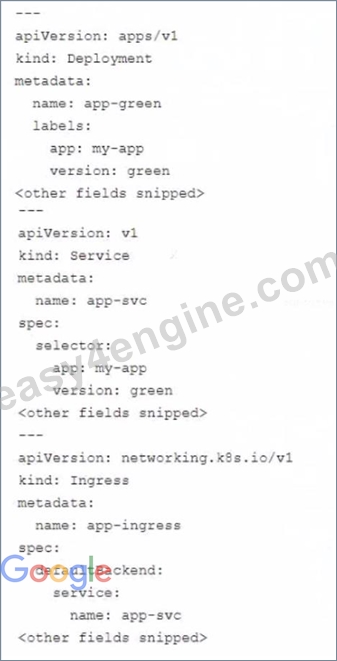
The Deployment app-green was updated to use the new version of the application During post-deployment monitoring you notice that the majority of user requests are failing You did not observe this behavior in the testing environment You need to mitigate the incident impact on users and enable the developers to troubleshoot the issue What should you do?
- A. Change the selector on the Service app-svc to app: my-app, version: blue
- B. Update the Deployment ape-green to use the previous version of the application
- C. Change the selector on the Service app-2vc to app: my-app.
- D. Update the Deployment app-blue to use the new version of the application
Answer: A
Explanation:
The best option for mitigating the incident impact on users and enabling the developers to troubleshoot the issue is to change the selector on the Service app-svc to app: my-app, version: blue. A Service is a resource that defines how to access a set of Pods. A selector is a field that specifies which Pods are selected by the Service. By changing the selector on the Service app-svc to app: my-app, version: blue, you can ensure that the Service only routes traffic to the Pods that have both labels app: my-app and version: blue. These Pods belong to the Deployment app-blue, which uses the previous version of the application. This way, you can mitigate the incident impact on users by switching back to the working version of the application. You can also enable the developers to troubleshoot the issue with the new version of the application in the Deployment app-green without affecting users.
NEW QUESTION # 109
You are performing a semiannual capacity planning exercise for your flagship service. You expect a service user growth rate of 10% month-over-month over the next six months. Your service is fully containerized and runs on Google Cloud Platform (GCP). using a Google Kubernetes Engine (GKE) Standard regional cluster on three zones with cluster autoscaler enabled. You currently consume about 30% of your total deployed CPU capacity, and you require resilience against the failure of a zone. You want to ensure that your users experience minimal negative impact as a result of this growth or as a result of zone failure, while avoiding unnecessary costs. How should you prepare to handle the predicted growth?
- A. Because you are at only 30% utilization, you have significant headroom and you won't need to add any additional capacity for this rate of growth.
- B. Proactively add 60% more node capacity to account for six months of 10% growth rate, and then perform a load test to make sure you have enough capacity.
- C. Verity the maximum node pool size, enable a horizontal pod autoscaler, and then perform a load test to verity your expected resource needs.
- D. Because you are deployed on GKE and are using a cluster autoscaler. your GKE cluster will scale automatically, regardless of growth rate.
Answer: C
NEW QUESTION # 110
Your organization wants to increase the availability target of an application from 99 9% to 99 99% for an investment of $2 000 The application's current revenue is S1,000,000 You need to determine whether the increase in availability is worth the investment for a single year of usage What should you do?
- A. Calculate the value of improved availability to be $1 000 and determine that the increase in availability is not worth the investment
- B. Calculate the value of improved availability to be $900, and determine that the increase in availability is not worth the investment
- C. Calculate the value of improved availability to be $1 000 and determine that the increase in availability is worth the investment
- D. Calculate the value of improved availability to be $9,000. and determine that the increase in availability is worth the investment
Answer: B
Explanation:
Explanation
The best option for determining whether the increase in availability is worth the investment for a single year of usage is to calculate the value of improved availability to be $900, and determine that the increase in availability is not worth the investment. To calculate the value of improved availability, we can use the following formula:
Value of improved availability = Revenue * (New availability - Current availability) Plugging in the given numbers, we get:
Value of improved availability = $1,000,000 * (0.9999 - 0.999) = $900
Since the value of improved availability is less than the investment of $2,000, we can conclude that the increase in availability is not worth the investment.
NEW QUESTION # 111
A third-party application needs to have a service account key to work properly When you try to export the key from your cloud project you receive an error "The organization policy constraint larn.disableServiceAccountKeyCreation is enforcedM You need to make the third-party application work while following Google-recommended security practices What should you do?
- A. Enable the default service account key. and download the key
- B. Remove the iam.disableServiceAccountKeyCreation policy at the organization level, and create a key.
- C. Add a rule to set the iam.disableServiceAccountKeyCreation policy to off in your project and create a key.
- D. Disable the service account key creation policy at the project's folder, and download the default key
Answer: C
Explanation:
The best option for making the third-party application work while following Google-recommended security practices is to add a rule to set the iam.disableServiceAccountKeyCreation policy to off in your project and create a key. The iam.disableServiceAccountKeyCreation policy is an organization policy that controls whether service account keys can be created in a project or organization. By default, this policy is set to on, which means that service account keys cannot be created. However, you can override this policy at a lower level, such as a project, by adding a rule to set it to off. This way, you can create a service account key for your project without affecting other projects or organizations. You should also follow the best practices for managing service account keys, such as rotating them regularly, storing them securely, and deleting them when they are no longer needed.
NEW QUESTION # 112
You are running an application in a virtual machine (VM) using a custom Debian image. The image has the Stackdriver Logging agent installed. The VM has the cloud-platform scope. The application is logging information via syslog. You want to use Stackdriver Logging in the Google Cloud Platform Console to visualize the logs. You notice that syslog is not showing up in the "All logs" dropdown list of the Logs Viewer. What is the first thing you should do?
- A. SSH to the VM and execute the following commands on your VM: ps ax I grep fluentd
- B. Look for the agent's test log entry in the Logs Viewer.
- C. Install the most recent version of the Stackdriver agent.
- D. Verify the VM service account access scope includes the monitoring.write scope.
Answer: A
Explanation:
https://cloud.google.com/compute/docs/access/service-accounts#associating_a_service_account_to_an_instance
NEW QUESTION # 113
You support a production service that runs on a single Compute Engine instance. You regularly need to spend time on recreating the service by deleting the crashing instance and creating a new instance based on the relevant image. You want to reduce the time spent performing manual operations while following Site Reliability Engineering principles. What should you do?
- A. Add a Load Balancer in front of the Compute Engine instance and use health checks to determine the system status.
- B. Create a Managed Instance Group with a single instance and use health checks to determine the system status.
- C. Create a Stackdriver Monitoring dashboard with SMS alerts to be able to start recreating the crashed instance promptly after it has crashed.
- D. File a bug with the development team so they can find the root cause of the crashing instance.
Answer: D
NEW QUESTION # 114
Your organization recently adopted a container-based workflow for application development. Your team develops numerous applications that are deployed continuously through an automated build pipeline to the production environment. A recent security audit alerted your team that the code pushed to production could contain vulnerabilities and that the existing tooling around virtual machine (VM) vulnerabilities no longer applies to the containerized environment. You need to ensure the security and patch level of all code running through the pipeline. What should you do?
- A. Set up Container Analysis to scan and report Common Vulnerabilities and Exposures.
- B. Configure the containers in the build pipeline to always update themselves before release.
- C. Reconfigure the existing operating system vulnerability software to exist inside the container.
- D. Implement static code analysis tooling against the Docker files used to create the containers.
Answer: A
NEW QUESTION # 115
You support a service with a well-defined Service Level Objective (SLO). Over the previous 6 months, your service has consistently met its SLO and customer satisfaction has been consistently high. Most of your service's operations tasks are automated and few repetitive tasks occur frequently. You want to optimize the balance between reliability and deployment velocity while following site reliability engineering best practices. What should you do? (Choose two.)
- A. Get the product team to prioritize reliability work over new features.
- B. Shift engineering time to other services that need more reliability.
- C. Change the implementation of your Service Level Indicators (SLIs) to increase coverage.
- D. Increase the service's deployment velocity and/or risk.
- E. Make the service's SLO more strict.
Answer: A,C
NEW QUESTION # 116
You are running an application in a virtual machine (VM) using a custom Debian image. The image has the Stackdriver Logging agent installed. The VM has the cloud-platform scope. The application is logging information via syslog. You want to use Stackdriver Logging in the Google Cloud Platform Console to visualize the logs. You notice that syslog is not showing up in the "All logs" dropdown list of the Logs Viewer. What is the first thing you should do?
- A. SSH to the VM and execute the following commands on your VM: ps ax I grep fluentd
- B. Look for the agent's test log entry in the Logs Viewer.
- C. Install the most recent version of the Stackdriver agent.
- D. Verify the VM service account access scope includes the monitoring.write scope.
Answer: A
NEW QUESTION # 117
You are using Terraform to manage infrastructure as code within a Cl/CD pipeline You notice that multiple copies of the entire infrastructure stack exist in your Google Cloud project, and a new copy is created each time a change to the existing infrastructure is made You need to optimize your cloud spend by ensuring that only a single instance of your infrastructure stack exists at a time. You want to follow Google-recommended practices What should you do?
- A. Confirm that the pipeline is storing and retrieving the terraform. if state file from Cloud Storage with the Terraform gcs backend
- B. Verify that the pipeline is storing and retrieving the terrafom.tfstat* file from a source control
- C. Create a new pipeline to delete old infrastructure stacks when they are no longer needed
- D. Update the pipeline to remove any existing infrastructure before you apply the latest configuration
Answer: A
Explanation:
Explanation
The best option for optimizing your cloud spend by ensuring that only a single instance of your infrastructure stack exists at a time is to confirm that the pipeline is storing and retrieving the terraform.tfstate file from Cloud Storage with the Terraform gcs backend. The terraform.tfstate file is a file that Terraform uses to store the current state of your infrastructure. The Terraform gcs backend is a backend type that allows you to store the terraform.tfstate file in a Cloud Storage bucket. By using the Terraform gcs backend, you can ensure that your pipeline has access to the latest state of your infrastructure and avoid creating multiple copies of the entire infrastructure stack.
NEW QUESTION # 118
You support a web application that runs on App Engine and uses CloudSQL and Cloud Storage for data storage. After a short spike in website traffic, you notice a big increase in latency for all user requests, increase in CPU use, and the number of processes running the application. Initial troubleshooting reveals:
After the initial spike in traffic, load levels returned to normal but users still experience high latency.
Requests for content from the CloudSQL database and images from Cloud Storage show the same high latency.
No changes were made to the website around the time the latency increased.
There is no increase in the number of errors to the users.
You expect another spike in website traffic in the coming days and want to make sure users don't experience latency. What should you do?
- A. Move the application from App Engine to Compute Engine.
- B. Modify the App Engine configuration to have additional idle instances.
- C. Upgrade the GCS buckets to Multi-Regional.
- D. Enable high availability on the CloudSQL instances.
Answer: B
Explanation:
Explanation
Scaling App Engine scales the number of instances automatically in response to processing volume. This scaling factors in the automatic_scaling settings that are provided on a per-version basis in the configuration file. A service with basic scaling is configured by setting the maximum number of instances in the max_instances parameter of the basic_scaling setting. The number of live instances scales with the processing volume. You configure the number of instances of each version in that service's configuration file. The number of instances usually corresponds to the size of a dataset being held in memory or the desired throughput for offline work. You can adjust the number of instances of a manually-scaled version very quickly, without stopping instances that are currently running, using the Modules API set_num_instances function.
https://cloud.google.com/appengine/docs/standard/python/how-instances-are-managed
https://cloud.google.com/appengine/docs/standard/python/config/appref
max_idle_instances Optional. The maximum number of idle instances that App Engine should maintain for this version. Specify a value from 1 to 1000. If not specified, the default value is automatic, which means App Engine will manage the number of idle instances. Keep the following in mind: A high maximum reduces the number of idle instances more gradually when load levels return to normal after a spike. This helps your application maintain steady performance through fluctuations in request load, but also raises the number of idle instances (and consequent running costs) during such periods of heavy load.
NEW QUESTION # 119
You encounter a large number of outages in the production systems you support. You receive alerts for all the outages that wake you up at night. The alerts are due to unhealthy systems that are automatically restarted within a minute. You want to set up a process that would prevent staff burnout while following Site Reliability Engineering practices. What should you do?
- A. Create an incident report for each of the alerts.
- B. Distribute the alerts to engineers in different time zones.
- C. Eliminate unactionable alerts.
- D. Redefine the related Service Level Objective so that the error budget is not exhausted.
Answer: C
Explanation:
Eliminate bad monitoring : Unactionable alerts (i.e., spam) https://cloud.google.com/blog/products/management-tools/meeting-reliability-challenges-with-sre-principles agree with kyubiblaze about having to remove unactionable items aka spam: "good monitoring alerts on actionable problems" @ https://cloud.google.com/blog/products/management-tools/meeting-reliability-challenges-with-sre-principles
NEW QUESTION # 120
Your application services run in Google Kubernetes Engine (GKE). You want to make sure that only images from your centrally-managed Google Container Registry (GCR) image registry in the altostrat-images project can be deployed to the cluster while minimizing development time. What should you do?
- A. Create a custom builder for Cloud Build that will only push images to gcr.io/altostrat-images.
- B. Add logic to the deployment pipeline to check that all manifests contain only images from gcr.io/altostrat-images.
- C. Add a tag to each image in gcr.io/altostrat-images and check that this tag is present when the image is deployed.
- D. Use a Binary Authorization policy that includes the whitelist name pattern gcr.io/attostrat-images/.
Answer: C
NEW QUESTION # 121
You need to deploy a new service to production. The service needs to automatically scale using a Managed Instance Group (MIG) and should be deployed over multiple regions. The service needs a large number of resources for each instance and you need to plan for capacity. What should you do?
- A. Use the n2-highcpu-96 machine type in the configuration of the MIG.
- B. Monitor results of Stackdriver Trace to determine the required amount of resources.
- C. Deploy the service in one region and use a global load balancer to route traffic to this region.
- D. Validate that the resource requirements are within the available quota limits of each region.
Answer: D
Explanation:
https://cloud.google.com/compute/quotas#understanding_quotas
https://cloud.google.com/compute/quotas
NEW QUESTION # 122
You are developing reusable infrastructure as code modules. Each module contains integration tests that launch the module in a test project. You are using GitHub for source control. You need to Continuously test your feature branch and ensure that all code is tested before changes are accepted. You need to implement a solution to automate the integration tests. What should you do?
- A. Use Cloud Build to run the tests. Trigger all tests to run after a pull request is merged.
- B. Use Cloud Build to run tests in a specific folder. Trigger Cloud Build for every GitHub pull request.
- C. Ask the pull request reviewers to run the integration tests before approving the code.
- D. Use a Jenkins server for Cl/CD pipelines. Periodically run all tests in the feature branch.
Answer: B
Explanation:
Explanation
Cloud Build is a service that executes your builds on Google Cloud Platform infrastructure. Cloud Build can import source code from Google Cloud Storage, Cloud Source Repositories, GitHub, or Bitbucket, execute a build to your specifications, and produce artifacts such as Docker containers or Java archives1. Cloud Build can also run integration tests as part of your build steps2.
You can use Cloud Build to run tests in a specific folder by specifying the path to the folder in the dir field of your build step3. For example, if you have a folder named tests that contains your integration tests, you can use the following build step to run them:
steps:
- name: 'gcr.io/cloud-builders/go'
args: ['test', '-v']
dir: 'tests'
Copy
You can use Cloud Build to trigger builds for every GitHub pull request by using the Cloud Build GitHub app. The app allows you to automatically build on Git pushes and pull requests and view your build results on GitHub and Google Cloud console4. You can configure the app to run builds on specific branches, tags, or paths5. For example, if you want to run builds on pull requests that target the master branch, you can use the following trigger configuration:
includedFiles:
- '**'
name: 'pull-request-trigger'
github:
name: 'my-repo'
owner: 'my-org'
pullRequest:
branch: '^master$'
Using Cloud Build to run tests in a specific folder and trigger builds for every GitHub pull request is a good way to continuously test your feature branch and ensure that all code is tested before changes are accepted.
This way, you can catch any errors or bugs early and prevent them from affecting the main branch.
Using a Jenkins server for CI/CD pipelines is not a bad option, but it would require more setup and maintenance than using Cloud Build, which is fully managed by Google Cloud. Periodically running all tests in the feature branch is not as efficient as running tests for every pull request, as it may delay the feedback loop and increase the risk of conflicts or failures.
Using Cloud Build to run the tests after a pull request is merged is not a good practice, as it may introduce errors or bugs into the main branch that could have been prevented by testing before merging.
Asking the pull request reviewers to run the integration tests before approving the code is not a reliable way of ensuring code quality, as it depends on human intervention and may be prone to errors or oversights.
References:
1: Overview | Cloud Build Documentation | Google Cloud
2: Running integration tests | Cloud Build Documentation | Google Cloud
3: Build configuration overview | Cloud Build Documentation | Google Cloud
4: Building repositories from GitHub | Cloud Build Documentation | Google Cloud
5: Creating GitHub app triggers | Cloud Build Documentation | Google Cloud
NEW QUESTION # 123
......
Google Dumps - Learn How To Deal With The Exam Anxiety: https://www.easy4engine.com/Professional-Cloud-DevOps-Engineer-test-engine.html
Ultimate Guide to Professional-Cloud-DevOps-Engineer Dumps - Enhance Your Future Career Now: https://drive.google.com/open?id=1xShJ4sHmO4eC8Plhm_gwS27KsTqw51mL
