

Latest OGEA-101 exam dumps with real The Open Group questions and answers
OGEA-101 Exam in First Attempt Guaranteed
NEW QUESTION # 27
The_________________ensures that a project transitioning into implementation also smoothly transitions into appropriate Architecture Governance.
- A. Migration Plan
- B. Transition Plan
- C. Implementation Strategy
- D. Implementation Governance Model
Answer: D
Explanation:
The Implementation Governance Model is a framework that defines the roles, responsibilities, processes, and standards for governing the implementation of the target architecture. It ensures that a project transitioning into implementation also smoothly transitions into appropriate Architecture Governance, which is the practice of ensuring compliance with the enterprise architecture and its principles, standards, and goals. The Implementation Governance Model is part of the Implementation and Migration Plan, which is the output of Phase F: Migration Planning of the Architecture Development Method (ADM)12 Reference: 1: The TOGAF Standard, Version 9.2, Part II: Architecture Development Method (ADM), Chapter 21: Phase F: Migration Planning 2: The TOGAF Standard, Version 9.2, Part VI: Architecture Capability Framework, Chapter 50: Architecture Governance
NEW QUESTION # 28
Consider the following ADM phases objectives.
Objective:
1.Develop the Target Data Architecture that enables the Business Architecture and the Architecture Vision
2.Develop the Target Business Architecture that describes how the enterprise needs to operate to achieve the business goals
3.Develop a high-level aspirational vision of the capabilities and business value to be delivered as a result of the proposed Enterprise Architecture
4.Identify candidate Architecture Roadmap components based upon gaps between the Baseline and Target Technology Architectures Which phase does each objective match?
- A. 1C-2B-3A-4D
- B. 1B-2D-3A-4C
- C. 1C-2D-3B-4A
- D. 1A-2B-3C-4D
Answer: A
Explanation:
*Phase A: Architecture Vision
oDevelop a high-level aspirational vision of the capabilities and business value to be delivered as a result of the proposed Enterprise Architecture oDefine the scope and boundaries of the architecture engagement oIdentify the key stakeholders and their concerns and expectations oDefine the Architecture Vision statement and the Architecture Definition Document oObtain approval and commitment from the sponsors and stakeholders
*Phase B: Business Architecture
oDevelop the Target Business Architecture that describes how the enterprise needs to operate to achieve the business goals oDefine the Baseline Business Architecture, if not available oPerform a gap analysis between the Baseline and Target Business Architectures oDefine candidate roadmap components for the Business Architecture oResolve impacts across the Architecture Landscape
*Phase C: Information Systems Architecture
oDevelop the Target Data Architecture that enables the Business Architecture and the Architecture Vision oDevelop the Target Application Architecture that supports the Business Architecture and the Architecture Vision oDefine the Baseline Data and Application Architectures, if not available oPerform a gap analysis between the Baseline and Target Data and Application Architectures oDefine candidate roadmap components for the Information Systems Architecture oResolve impacts across the Architecture Landscape
*Phase D: Technology Architecture
oDevelop the Target Technology Architecture that enables the Information Systems Architecture and the Architecture Vision oDefine the Baseline Technology Architecture, if not available oPerform a gap analysis between the Baseline and Target Technology Architectures oIdentify candidate Architecture Roadmap components based upon gaps between the Baseline and Target Technology Architectures oResolve impacts across the Architecture Landscape Therefore, the correct matching of the objectives and the phases is:
*1C: Develop the Target Data Architecture that enables the Business Architecture and the Architecture Vision
*2B: Develop the Target Business Architecture that describes how the enterprise needs to operate to achieve the business goals
*3A: Develop a high-level aspirational vision of the capabilities and business value to be delivered as a result of the proposed Enterprise Architecture
*4D: Identify candidate Architecture Roadmap components based upon gaps between the Baseline and Target Technology Architectures References: 1: The TOGAF Architecture Development Method
NEW QUESTION # 29
Consider the following descriptions of deliverables consumed and produced across the TOGAF ADM cycle.
General rules and guidelines, intended to be enduring and seldom
amended, that inform and support the way in which an organization sets
about fulfilling its mission
The joint agreements between development partners and sponsors on the
deliverables, quality, and fitness-for-purpose of an architecture.
A document that is sent from the sponsoring organization to the
architecture organization to trigger the start of an architecture
development cycle
A set of quantitative statements that outline what an implementation
project must do in order to comply with the architecture.
Which deliverables match these descriptions?
1 Architecture Principles -2 Architecture Contracts - 3 Request for Architecture Work - 4 Architecture Requirements Specification
1 Architecture Contracts - 2 Architecture Requirements Specification - 3 Architecture Vision - 4 Architecture Principles
1 Architecture Requirements Specification -2 Architecture Principles - 3 Architecture Vision - 4 Architecture Contracts
1 Architecture Principles -2 Architecture Contracts - 3 Architecture Requirements Specification-4 Request for Architecture Work Explanation:
Answer:
Explanation:
According to the TOGAF standard, the deliverables that match the descriptions are as follows:
1 Architecture Principles: These are general rules and guidelines, intended to be enduring and seldom amended, that inform and support the way in which an organization sets about fulfilling its mission1. They reflect a level of consensus among the various elements of the enterprise, and form the basis for making future IT decisions1.
2 Architecture Contracts: These are the joint agreements between development partners and sponsors on the deliverables, quality, and fitness-for-purpose of an architecture2. They are used to ensure that the architecture is implemented and governed according to the agreed-upon specifications and standards2.
3 Request for Architecture Work: This is a document that is sent from the sponsoring organization to the architecture organization to trigger the start of an architecture development cycle3. It defines the scope, schedule, budget, deliverables, and stakeholders of the architecture project3.
4 Architecture Requirements Specification: This is a set of quantitative statements that outline what an implementation project must do in order to comply with the architecture4. It defines the requirements for each architecture domain, as well as the relationships and dependencies among them4.
1: Architecture Principles 2: Architecture Contracts 3: Request for Architecture Work 4: Architecture Requirements Specification
NEW QUESTION # 30
Complete the following sentence. In the ADM, documents which are under development and have not undergone any formal review and approval process are _________
- A. in between phases
- B. invalid
- C. called "draft"
- D. known as "Version 0.1"
Answer: C
NEW QUESTION # 31
Complete the sentence Business Transformation Readiness Assessment is_________________.
- A. a way to put building blocks into context thereby supporting re-usable solutions
- B. to ensure the active support of powerful stakeholders
- C. a joint effort between corporate staff lines of business and IT planners
- D. widely used to validate an architecture that is being developed
Answer: C
Explanation:
Business Transformation Readiness Assessment is a joint effort between corporate staff lines of business and IT planners to evaluate the readiness of the organization to undergo change. It involves assessing factors such as vision, commitment, capacity, capability, culture, and motivation that may influence the success of a business transformation initiative. Reference: The TOGAF Standard | The Open Group Website, Section
3.3.2 Business Transformation Readiness Assessment.
NEW QUESTION # 32
Consider the following statements:
1. Each contracted party is required to act responsibly to the organization and its stakeholders.
2. All decisions taken, processes used, and their implementation will not be allowed to create unfair advantage to any one particular party.
3. Digital Transformation and operations will be more effective and efficient.
4. Strategic decision-making by C-Level executives and business leaders will be more effective.
Which statements highlight the value and necessity for Architecture Governance to be adopted within organizations?
- A. 2 & 3
- B. 1 & 2
- C. 1 & 4
- D. 3 & 4
Answer: B
Explanation:
Architecture governance is the practice of ensuring compliance with the enterprise architecture and its principles, standards, and goals. Architecture governance provides the means to establish, monitor, and control the architecture development and implementation processes, and to resolve any issues or conflicts that may arise. Architecture governance also ensures that all stakeholders are represented and involved in the decision-making process, and that their interests and concerns are balanced and aligned. Statements 1 and 2 highlight the value and necessity for architecture governance to be adopted within organizations, as they emphasize the importance of responsibility, accountability, fairness, and transparency in the architectural activities. Statements 3 and 4 are more related to the benefits and outcomes of having a good enterprise architecture, rather than the governance aspect.Reference: : The TOGAF Standard, Version 9.2, Part VI: Architecture Capability Framework, Chapter 50: Architecture Governance : The TOGAF Standard, Version 9.2, Part III: ADM Guidelines and Techniques, Chapter 29: Architecture Governance
NEW QUESTION # 33
Complete the sentence. Risks are identified as part of:
- A. A Business Scenario, understanding business requirements
- B. Phase B, assessing readiness for change
- C. Preliminary Phase, Gap Analysis
- D. Phase A, Business Transformation Readiness Assessment
Answer: A
Explanation:
(ADM Inputs/Outputs for early phases include Business Scenario/Architecture Vision content, with "Risks and issues" explicitly listed.) - "Business Scenario / Architecture Vision... Risks and issues ..." www.
opengroup.org
Reference: The Open Group (archived TOGAF materials), ADM Input and Output Descriptions.
NEW QUESTION # 34
What are the following activities part of?
* Initial risk assessment
* Risk mitigation and residual risk assessment
* Risk monitoring
- A. Phase A
- B. Security Architecture
- C. Phase C
- D. Risk Management
Answer: D
Explanation:
The following activities are part of Risk Management:
Initial risk assessment
Risk mitigation and residual risk assessment
Risk monitoring
Risk Management is the process of identifying, assessing, and responding to risks that may affect the achievement of the enterprise's objectives. Risk Management involves balancing positive and negative outcomes resulting from the realization of either opportunities or threats. Reference: The TOGAF Standard | The Open Group Website, Section 3.3.3 Risk Management.
NEW QUESTION # 35
Which of the following best describes the need for the ADM process to be governed?
- A. To enable development of reference architectures
- B. To permit the architecture domains to be integrated
- C. To verify that the method is being applied correctly
- D. To enable a fast response to market changes
Answer: C
Explanation:
According to the TOGAF standard, the need for the ADM process to be governed is to ensure that the architecture development and implementation activities are conducted in a consistent, coherent, and compliant manner1. Governance provides the means to verify that the method is being applied correctly and effectively, and that the architecture deliverables and artifacts meet the quality and standards criteria1. Governance also enables the management of risks, issues, changes, and dependencies that may arise during the ADM process1.
Some of the benefits of governing the ADM process are2:
* Improved alignment of the architecture with the business strategy and objectives
* Enhanced stakeholder engagement and communication
* Increased reuse and integration of architecture assets and resources
* Reduced complexity and duplication of architecture efforts
* Increased agility and adaptability of the architecture to changing needs and requirements
* Improved compliance and auditability of the architecture outcomes and outputs
NEW QUESTION # 36
Refer to the table below: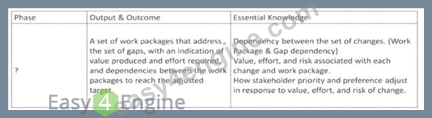
Which ADM Phase(s) does this describe?
- A. Phase B, C and D
- B. Phase A
- C. Phase F
- D. Phase E
Answer: C
NEW QUESTION # 37
Which of the following describes a purpose of Architecture Principles?
- A. To provide a better understanding about the enterprise's culture and values
- B. To establish a common understanding of how to control the business in pursuit of strategic objectives
- C. To describe likely impacts resulting from successful deployment of the target architecture.
- D. To form a contract between sponsoring organization and the enterprise architects
Answer: B
Explanation:
Architecture Principles are general rules and guidelines that inform and support the way in which an organization sets about fulfilling its mission. They reflect a level of consensus among the various elements of the enterprise, and form the basis for making future IT decisions. One of the purposes of Architecture Principles is to establish a common understanding of how to control the business in pursuit of strategic objectives, by providing a framework for evaluating and agreeing on the changes that affect the enterprise's architecture3 Reference: 3: The TOGAF Standard, Version 9.2, Part III: ADM Guidelines and Techniques, Chapter 23: Architecture Principles : The TOGAF Standard, Version 9.2, Part IV: Architecture Content Framework, Chapter 31: Architecture Principles
NEW QUESTION # 38
Consider the illustration.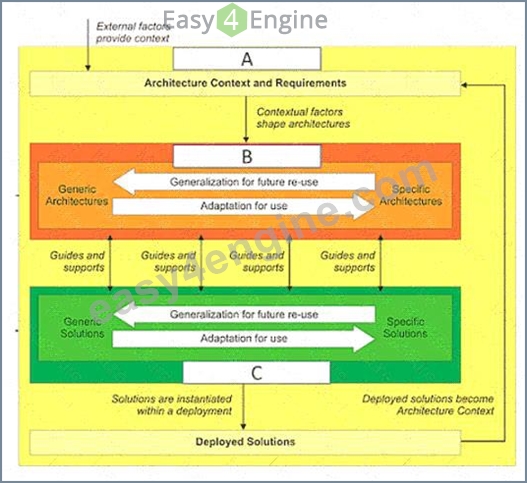
What are the items labelled A, B and C?
- A. A-Architecture Vision, B-Business Architecture, C-Information Systems Architecture
- B. A-Enterprise Architecture, B-Architecture Building Blocks, C-Solutions Building Blocks
- C. A-Enterprise Strategic Architecture, B-Segment Architecture, C-Solutions Architecture
- D. A-Enterprise Continuum, B-Architecture Continuum, C-Solutions Continuum
Answer: D
Explanation:
The illustration shows the relationship between the Enterprise Continuum, the Architecture Continuum, and the Solutions Continuum, which are key concepts in the TOGAF framework. The Enterprise Continuum is a view of the Architecture Repository that shows how generic foundation architectures can be leveraged and specialized to support the requirements of an individual organization. The Architecture Continuum specifies a structured classification for architectural artifacts, such as models, patterns, and descriptions, that can be reused and adapted across different domains and levels of abstraction. The Solutions Continuum identifies implemented solutions that support various stages of business and IT capability evolution, such as common systems, industry solutions, and organization-specific solutions. The illustration also shows how the architecture context and requirements are influenced by external factors, such as business drivers, stakeholders, and standards, and how they shape the generic and specific architectures and solutions. The illustration also shows how the deployed solutions become part of the architecture context for future iterations of the architecture development cycle. References:
*TOGAF Standard, 10th Edition, Part II: Architecture Development Method, Chapter 6: Architecture Repository, Section 6.2 Enterprise Continuum.
*TOGAF Standard, 10th Edition, Part IV: Architecture Content Framework, Chapter 35: Enterprise Continuum and Tools, Section 35.1 Introduction.
NEW QUESTION # 39
Which ADM Phase includes initial implementation planning?
- A. Phase A
- B. Preliminary
- C. Phase H
- D. Phase E
Answer: D
Explanation:
In TOGAF, Phase E (Opportunities & Solutions) is the first phase that transitions from architecture models into actionable implementation. Within Phase E, architects identify candidate implementation projects or work packages, assess dependencies, cost/benefit, constraints, and derive a high#level implementation and migration strategy and initial plans. That means the first planning around how to carry out the architecture begins in Phase E. Later phases refine and govern the implementation (e.g. in Phase F and G), but the initial planning belongs in Phase E. Thus Phase E includes the initial implementation planning.
NEW QUESTION # 40
Consider the following chart: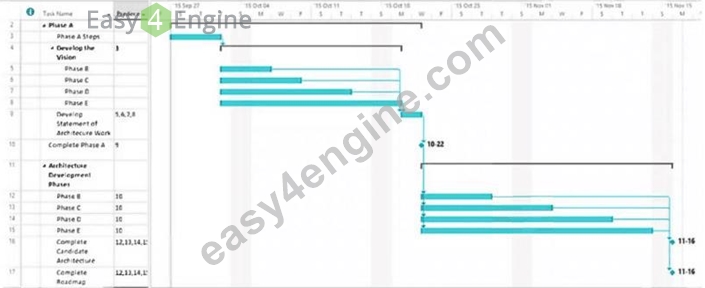
Which important concept for Enterprise Architecture Practitioners does it illustrate?
- A. ADM phases must be run simultaneously until the relevant information has been produced.
- B. An Enterprise Architecture must be developed in phases with a limited fixed duration.
- C. Enterprise Architects must use Gantt charts to communicate with Stakeholders.
- D. ADM phases must be run in a sequenced approach to produce the Architecture.
Answer: D
Explanation:
The chart shown is a Gantt chart, which is commonly used for project management to illustrate a project schedule. In the context of TOGAF (The Open Group Architecture Framework), which is a framework for enterprise architecture, this Gantt chart is demonstrating the sequenced approach to the Architecture Development Method (ADM). The ADM is the core process of TOGAF which provides a tested and repeatable process for developing architectures. The ADM is described as being iterative, over the whole process, between phases, and within phases. For each iteration of the ADM, a fresh decision must be taken about each of the parameters (scope, granularity, time period, and architecture assets).
The ADM consists of a number of phases that have to be followed in sequence:
Preliminary Phase: Framework and principles
Phase A: Architecture Vision
Phase B: Business Architecture
Phase C: Information Systems Architectures, including Data and Application Architectures Phase D: Technology Architecture Phase E: Opportunities and Solutions Phase F: Migration Planning Phase G: Implementation Governance Phase H: Architecture Change Management Requirements Management Each phase is dependent on the outputs of the previous phase and the Requirements Management phase runs throughout. The Gantt chart clearly shows the dependency and sequence in which these phases occur, implying that a structured approach is followed to produce the enterprise architecture.
The TOGAF Standard, Version 9.2, a standard of The Open Group
The TOGAF documentation available at https://publications.opengroup.org/standards/architecture and
https://publications.opengroup.org/guides/architecture
NEW QUESTION # 41
Refer to the table below: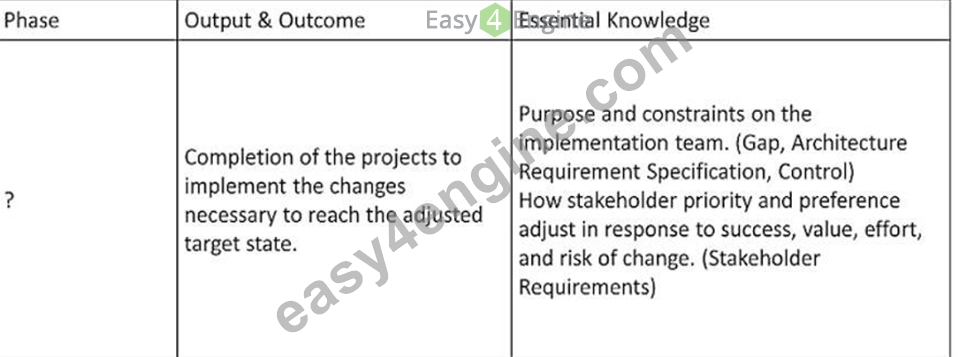
Which ADM Phase does this describe?
- A. Phase A
- B. Phase G
- C. Phase E
- D. Phase F
Answer: B
Explanation:
The table describes the output, outcome, and essential knowledge of an ADM phase that oversees the implementation of changes necessary to reach the adjusted target state. This corresponds to Phase G, also known as Implementation Governance, which ensures that the architecture defined in earlier phases is realized, and it oversees the development and implementation of projects to align with this architecture. The essential knowledge required during this phase includes understanding constraints on the implementation team and adjusting stakeholder priority and preference in response to success, value, effort, and risk of change. References: TOGAF Version 9.1 - 1
NEW QUESTION # 42
Which of the following best describes the purpose of the Gap Analysis technique?
- A. To govern the architecture throughout its implementation process
- B. To identify items omitted from the Target Architecture
- C. To allocate resources for architecture projects
- D. To develop a set of general rules and guidelines for the architecture
Answer: B
Explanation:
The purpose of the Gap Analysis technique is similar to the previous question, but with a focus on the Target Architecture. The technique helps to identify the items that are not included or specified in the Target Architecture, such as capabilities, services, components, standards, or technologies. These items may be essential for achieving the vision and goals of the enterprise, or for addressing the stakeholder concerns and requirements. By identifying the items omitted from the Target Architecture, the technique helps to ensure that the architecture is comprehensive, feasible, and realistic.
NEW QUESTION # 43
Which of the following best describes the need for the ADM process to be governed?
- A. To enable development of reference architectures
- B. To permit the architecture domains to be integrated
- C. To verify that the method is being applied correctly
- D. To enable a fast response to market changes
Answer: C
Explanation:
According to the TOGAF standard, the need for the ADM process to be governed is to ensure that the architecture development and implementation activities are conducted in a consistent, coherent, and compliant manner1. Governance provides the means to verify that the method is being applied correctly and effectively, and that the architecture deliverables and artifacts meet the quality and standards criteria1. Governance also enables the management of risks, issues, changes, and dependencies that may arise during the ADM process1.
Some of the benefits of governing the ADM process are2:
*Improved alignment of the architecture with the business strategy and objectives
*Enhanced stakeholder engagement and communication
*Increased reuse and integration of architecture assets and resources
*Reduced complexity and duplication of architecture efforts
*Increased agility and adaptability of the architecture to changing needs and requirements
*Improved compliance and auditability of the architecture outcomes and outputs
NEW QUESTION # 44
Consider the illustration.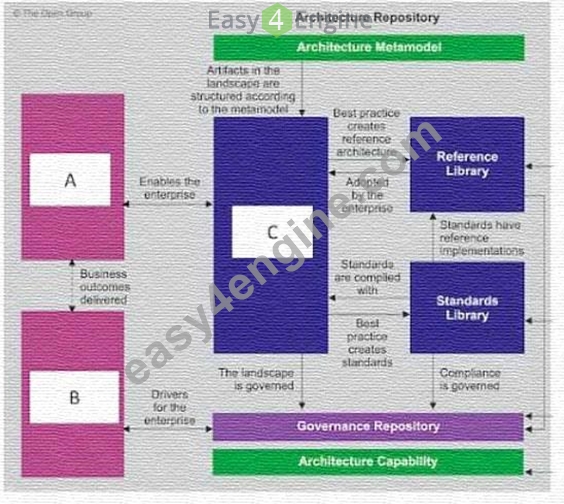
What are the items labelled A B and C?
- A. A-Solution Landscape, B-Architecture Requirements Repository. C-Architecture Landscape
- B. A-EA Landscape, B-Requirements Repository. C-Artifacts Landscape
- C. A-Architecture Requirements Repository, B-Solutions Repository, C-Architecture Landscape
- D. A-Architecture Landscape B-Architecture Requirements Repository C-Solutions Landscape
Answer: C
Explanation:
This aligns with the TOGAF Architecture Repository model where:
A (Architecture Requirements Repository) contains requirements that drive architecture work.
B (Solutions Repository) stores the building blocks or solutions that support the architecture.
C (Architecture Landscape) represents the architecture assets that depict the current, transition, and target architecture states across the enterprise
NEW QUESTION # 45
Consider the following descriptions of deliverables consumed and produced across the TOGAF ADM cycle.
General rules and guidelines, intended to be enduring and seldom
amended, that inform and support the way in which an organization sets
about fulfilling its mission
The joint agreements between development partners and sponsors on the
deliverables, quality, and fitness-for-purpose of an architecture.
A document that is sent from the sponsoring organization to the
architecture organization to trigger the start of an architecture
development cycle
A set of quantitative statements that outline what an implementation
project must do in order to comply with the architecture.
Which deliverables match these descriptions?
- A. 1 Architecture Principles -2 Architecture Contracts - 3 Architecture Requirements Specification-4 Request for Architecture Work Explanation:
- B. 1 Architecture Principles -2 Architecture Contracts - 3 Request for Architecture Work - 4 Architecture Requirements Specification
- C. 1 Architecture Requirements Specification -2 Architecture Principles - 3 Architecture Vision - 4 Architecture Contracts
- D. 1 Architecture Contracts - 2 Architecture Requirements Specification - 3 Architecture Vision - 4 Architecture Principles
Answer: B
Explanation:
According to the TOGAF standard, the deliverables that match the descriptions are as follows:
1 Architecture Principles: These are general rules and guidelines, intended to be enduring and seldom amended, that inform and support the way in which an organization sets about fulfilling its mission1. They reflect a level of consensus among the various elements of the enterprise, and form the basis for making future IT decisions1.
2 Architecture Contracts: These are the joint agreements between development partners and sponsors on the deliverables, quality, and fitness-for-purpose of an architecture2. They are used to ensure that the architecture is implemented and governed according to the agreed-upon specifications and standards2.
3 Request for Architecture Work: This is a document that is sent from the sponsoring organization to the architecture organization to trigger the start of an architecture development cycle3. It defines the scope, schedule, budget, deliverables, and stakeholders of the architecture project3.
4 Architecture Requirements Specification: This is a set of quantitative statements that outline what an implementation project must do in order to comply with the architecture4. It defines the requirements for each architecture domain, as well as the relationships and dependencies among them4.
1: Architecture Principles 2: Architecture Contracts 3: Request for Architecture Work 4: Architecture Requirements Specification
NEW QUESTION # 46
What information does the Architecture Requirements Repository within the Architecture Repository hold?
- A. The architecture requirements which have been agreed with the Architecture Board
- B. A set of guidelines, templates, and patterns to support the development of architecture requirements
- C. A log of the governance activity related to architecture requirements
- D. The parameters and structures to support governance of architecture requirements
Answer: A
NEW QUESTION # 47
When considering the scope of an architecture, what dimension considers to what level of detail the architecting effort should go?
- A. Depth
- B. Breadth
- C. Project
- D. Architecture Domains
Answer: A
Explanation:
The scope of an architecture is the extent and level of detail of the architecture work. The scope of an architecture can be defined along four dimensions: project, breadth, depth, and architecture domains. The project dimension considers the boundaries and objectives of the architecture project, such as the time frame, budget, resources, and deliverables. The breadth dimension considers the coverage and completeness of the architecture across the enterprise, such as the organizational units, business functions, processes, and locations. The depth dimension considers the level of detail and specificity of the architecture, such as the granularity, abstraction, and precision of the architectural elements and relationships. The architecture domains dimension considers the aspects or segments of the architecture, such as the business, data, application, and technology domains.
Therefore, the depth dimension is the one that considers to what level of detail the architecting effort should go.
NEW QUESTION # 48
Which of the following best summarizes the purpose of Enterprise Architecture?
- A. Governing the Stakeholders.
- B. Controlling the bigger changes.
- C. Taking major improvement decisions.
- D. Guiding effective change.
Answer: D
Explanation:
EA applies architecture principles and practices to analyze, design, plan, and implement enterprise analysis that supports digital transformation, IT growth, and the modernization of IT2. EA also helps organizations improve the efficiency, timeliness, and reliability of business information, as well as the alignment, agility, and adaptability of the architecture to the changing needs and requirements3. Therefore, the best summary of the purpose of EA is to guide effective change.
References: 1: Enterprise architecture - Wikipedia 2: What is enterprise architecture? A framework for transformation 3: 3 The Purpose of Enterprise Architecture - The Open Group
NEW QUESTION # 49
Which ADM phase focuses on defining the problem to be solved, identifying the stakeholders, their concerns, and requirements?
- A. Phase A
- B. Phase
- C. Phase
- D. Preliminary Phase
Answer: A
Explanation:
Phase A: Architecture Vision is the first phase of the Architecture Development Method (ADM) cycle, which is the core of the TOGAF standard. The main purpose of this phase is to define the scope and approach of the architecture development, and to create the Architecture Vision, which is a high-level description of the desired outcomes and benefits of the proposed architecture. To achieve this purpose, this phase focuses on defining the problem to be solved, identifying the stakeholders, their concerns, and requirements, and establishing the business goals and drivers that motivate the architecture work. This phase also involves obtaining the approval and commitment of the sponsors and other key stakeholders, and initiating the Architecture Governance process.
NEW QUESTION # 50
Which one of the following classes of information within the Architecture Repository would typically contain a list of the applications in use within the enterprise?
- A. Governance Log
- B. Architecture Metamodel
- C. Reference Library
- D. Architecture Landscape
Answer: D
Explanation:
The Architecture Landscape is a class of information within the Architecture Repository that shows an architectural view of the building blocks that are in use within the organization today (the Baseline Architecture), as well as those that are planned for the future (the Target Architecture). The Architecture Landscape typically contains a list of the applications in use within the enterprise, along with their relationships and dependencies, as well as other relevant architectural information. The Architecture Landscape helps to identify opportunities for re-use, consolidation, or retirement of existing applications, as well as gaps or overlaps in the current or future architecture.
The TOGAF Standard, Version 9.2, Part IV: Architecture Content Framework, Chapter 34: Architecture Landscape : The TOGAF Standard, Version 9.2, Part VI: Architecture Capability Framework, Chapter 47:
Architecture Repository
NEW QUESTION # 51
......
Exam Sure Pass The Open Group Certification with OGEA-101 exam questions: https://www.easy4engine.com/OGEA-101-test-engine.html
Download Real OGEA-101 Exam Dumps for candidates. 100% Free Dump Files: https://drive.google.com/open?id=13vdiWZE6XUr7S7zClorM2nB0bd9uQzxm
